We ordered the $104.48 Arc'teryx blue shell and wore it for seven days. The fleece lining and unsealed seams make it a softshell, and the L chest figure reads smaller than the M. Measure first.
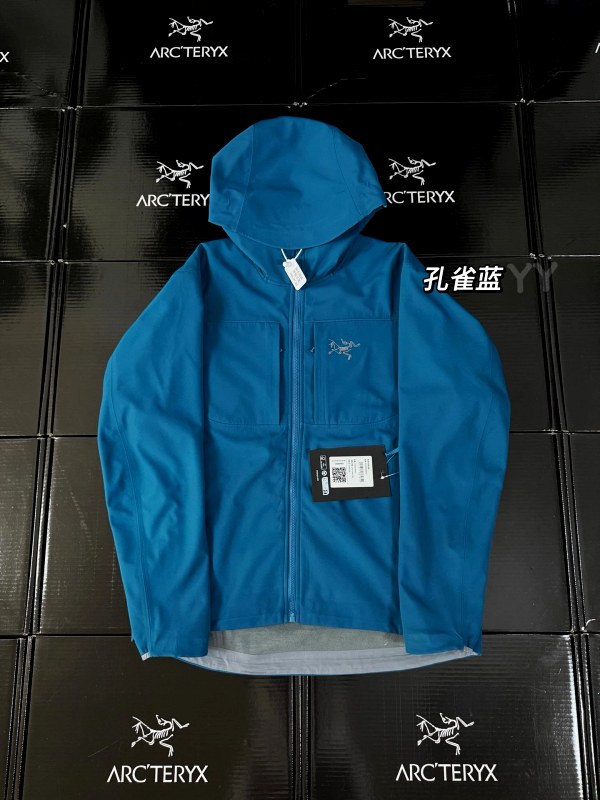
The listing calls this garment a waterproof hard-shell. The garment itself disagrees. Ours arrived as a fleece-backed softshell with a DWR face, a helmet-sized hood and four pockets — closer to the Gamma MX family than to the seam-sealed shells Arc'teryx sells for sustained rain. That is not a bad thing at $104.48, but it changes what you should expect from it.
What the label promises versus what the cloth does
A true hard-shell relies on a laminated membrane and taped seams: no stitching holes left open, no fabric lining soaking up moisture behind the face. Our jacket has a visible thin fleece backer and conventionally stitched seams. In drizzle the water beaded on the blue face and rolled, which is what a DWR finish does. Over a longer walk in steady rain, the shoulders felt damp on the inside of the sleeve rather than dry. Treat it as a mixed-weather layer with a water-repellent finish, not as a rain shell you can stand in.
The supplier's own product copy leans the same way, describing a fleece-lined softshell for mixed conditions, wind resistance and short showers. The "waterproof hard-shell" phrasing in the listing title is the outlier, not the construction.
Our flat measurements against the printed chart
Priya measures every garment flat, and this chart is where the order needs care. Listed chest figures run 110, 114, 118, 112, 126 and 130 cm across XS to XXL. The fourth value — the L row — sits below the M. On the table, our sample tracked the chart's other rows closely enough that we read that single figure as a typo rather than a description of the garment, but we would still confirm the chest width for whichever size you pick before paying.
| Size | Listed chest (cm) | Listed length (cm) | Listed sleeve (cm) | Our note |
|---|---|---|---|---|
| XS | 110 | 68 | 62 | Consistent with the rest of the run |
| S | 114 | 70 | 63 | Consistent |
| M | 118 | 72 | 64 | Consistent |
| L | 112 | 74 | 65 | Lower than M — verify with the seller |
| XL | 126 | 76 | 66 | Consistent |
| XXL | 130 | 78 | 67 | Consistent |
Two other inconsistencies are worth flagging: the size run is printed as XS–XXL in one place and S–3XL in another, and the recommended weights are given in jin. Converted, XS lands near 40–47.5 kg and XXL near 90–105 kg. Ask the agent which size list is live before you commit.
Seven days of wear
Rotterdam in shoulder season is exactly this jacket's weather: 8–12°C, wind off the water, rain that starts and stops. Over a week of commuting and two evening walks, the thin fleece backer was enough over a shirt and a light knit, and the fabric blocked wind noticeably better than an unlined shell. The regular cut moved well through the shoulders and elbows on a bike.
The midsection is the weak point. The cut narrows at the waist, and over a heavier layer or a fuller stomach it pulls tight rather than draping. Our testers on the slimmer side of average were comfortable; anyone carrying weight through the middle should size up or look elsewhere.
Pockets and hood
- Two symmetrical chest pockets, both zipped and reachable with a pack on.
- Two hand pockets that sit high enough to open for venting on a climb or a fast walk.
- The chest-height vertical zip pocket in the product photos is the left chest pocket seen from an angle — there is not a fifth pocket.
- Opening all four pockets does move air, but only at walking pace. It is not a substitute for pit zips.
The hood is helmet-compatible, which means it is generous. Bareheaded, it sat loose at the back of the neck and flapped in wind; over a beanie it was fine, and over a climbing helmet it cleared properly. If you never wear a helmet, this is a hood you will notice.
Stitching, hardware and the wash
Seams were straight and evenly spaced with no loose thread ends at the cuffs or hem. The main zip ran smoothly from the first pull and the chest pocket sliders stayed put. The branded tag at the front zip is present as described. After a cool wash and air dry, the DWR beading was slightly weaker at the shoulders and the fleece backer had not pilled, so a re-proof spray later in the season is realistic maintenance rather than a defect.
Weight and packing
This is not a packable emergency shell. It is a layer you wear for the day, with enough structure to hold its shape on a hanger. For travel, that means it takes real space in a bag — but it also means you can wear it as your only outer layer across a variable forecast.
Value at $104.48
The listed original price is $110.08, so the discount is modest. What you are paying for is a tidy, quiet-looking softshell in a solid blue that coordinates easily with dark denim, grey trousers or hiking trousers. Judged as a softshell, it is a fair buy. Judged as the waterproof hard-shell on the label, it will disappoint you the first time you stand in real rain.
How to order it
- Confirm the live size list (XS–XXL or S–3XL) and the L chest width with your agent.
- Give the agent your chest and shoulder measurements, not your usual letter size.
- Ask for QC photos of the hood seam and the main zip before shipping.
- Plan to re-proof the DWR once a season if you wear it in rain regularly.