We ordered the khaki SV7 through an agent, measured it flat, wore it for seven days and washed it three times. The build held up; the GORE-TEX claim and the two size charts did not resolve.
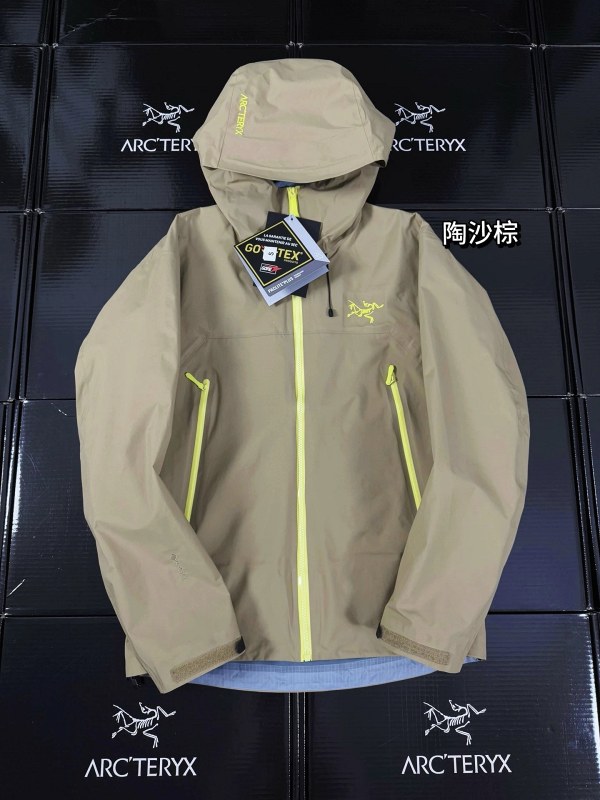
We ordered the Arc'teryx Khaki SV7 Hard Shell Jacket through a shopping agent on 12 August and it reached our Rotterdam desk nine days later, folded into a plain poly bag with no retail box. The jacket is khaki, with bright yellow tape running down the main zip and along both hand pockets, plus a contrasting chest logo. On our scale, a size M weighs 398 g — light for anything carrying a "Severe" badge.
How we tested
Priya Nair measured every panel flat before the jacket was worn, then checked the numbers against the agent's published chart. The sample then went through seven days of Rotterdam commuting and two short coastal walks, including one 40-minute stretch in steady rain. It was washed three times at 30°C with no tumble drying. We logged seam tape, zipper branding, cuff hardware, hood adjustment and water beading after each wash.
Flat measurements, size M
| Measurement | Our flat result | Note |
|---|---|---|
| Pit-to-pit, zipped | 58 cm | Room for a midweight fleece |
| Hem width, flat | 56 cm | Drawcord cinches roughly 8 cm |
| Back length | 72 cm | Collar seam to hem |
| Sleeve, shoulder to cuff | 62 cm | Cuff covers a glove cuff when extended |
| Cuff opening, relaxed | 13 cm | Hook-and-loop tab takes up about 6 cm |
| Pit zip length | 30 cm | Two-way YKK sliders |
| Weight, size M | 398 g | Our calibrated scale |
The GORE-TEX question
The listing names a 70D recycled nylon in high-wear areas, 40D elsewhere and a GORE C-Knit backer, presented as a Beta Lightweight 2024 construction reference. Our sample carried no membrane branding on the care label or the seam tape, and the internal tag we could read listed fabric composition without naming a laminate. We are not able to confirm the GORE-TEX claim from the garment itself. What we can report is what we saw: taped seams at the collar, shoulders and side seams, a four-layer pressed chest logo, and tidy single-needle stitching along the hem.
There is a second inconsistency. The product is named SV7, but Arc'teryx's published suffix scheme uses SV for Severe and does not document a "7" tier; nothing we found describes an SV7 model. The listing copy itself repeatedly references a Beta Lightweight. Treat the name as a listing label until the seller or a swing tag resolves it.
Hood, cuffs and hem
The hood is the best-finished part of the jacket. It has a single rear adjuster and two side pulls, sits clear of the eyes when cinched, and turns with the head rather than sliding across it. There is no wire brim, so in driving rain the front edge wets out and softens. The hook-and-loop cuffs are broad and grip well; we tightened them over gloves twice without the tabs peeling. The hem drawcord runs through a clean channel and holds its setting under load.
Pit zips and pockets
Both underarm vents use two-way YKK sliders, and 30 cm of opening is enough to dump heat on a climb. The hand pockets sit just above the hem and are reachable with a hip belt on; the WaterTight-style zippers ran smoothly every time but are not the fully taped type. A high chest pocket would have been more useful for a phone in rain, and there isn't one.
Water and wind on the Maas
In steady rain the khaki face fabric beaded immediately and the shoulders stayed dry for the full 40 minutes. After an hour of standing around, damp appeared at the cuffs and along the front zip flap — normal for a shell of this class, but worth knowing if you commute on a bike. Wind resistance was good: a 40 km/h gust off the water did not cut through when we wore a fleece underneath.
Three washes later
We washed at 30°C with a technical wash, no softener, no tumble dry. Seam tape stayed flat at the collar and shoulders, stitching held, and the yellow zip tape did not bleed into the khaki body. Beading weakened noticeably by the third wash — water still ran off but began to darken the fabric at the shoulders. Plan on a spray-on DWR refresh each season. A long-term owner report on a different Arc'teryx shell describes seam tape delaminating after a wash without tumble drying, so we deliberately checked that area after every cycle and found no lifting in our sample.
Sizing: two charts, one jacket
The listing shows XS–XXL in one place and S–3XL in a separate spec line, and asks buyers to supply height and weight at checkout. That means the published chart alone may not map to the garment you receive. We sized to a jacket we already layer over a fleece and found our M generous through the chest and correct in the sleeve. Before ordering, measure the chest width, back length and sleeve of a shell you already wear, send those numbers to the agent, and ask for the flat measurement of the exact size on offer.
What $141 buys
At $141.04, discounted from $156.98 and listed as in stock, the value sits in the hardware and finishing rather than in a verifiable laminate: functional two-way pit zips, a genuinely good hood, secure cuffs, and stitching that survived our test period. Buyers should go in expecting an honest drizzle-and-wind shell with an unresolved spec sheet, not an alpine garment — and should confirm the fabric label and the size chart with the agent before paying.