We ordered the $137 Arc'teryx Polar White hard shell through an agent, measured it flat in size M and wore it through a wet Rotterdam week. Beading held; the bright face fabric and unverified membrane details are the open questions.
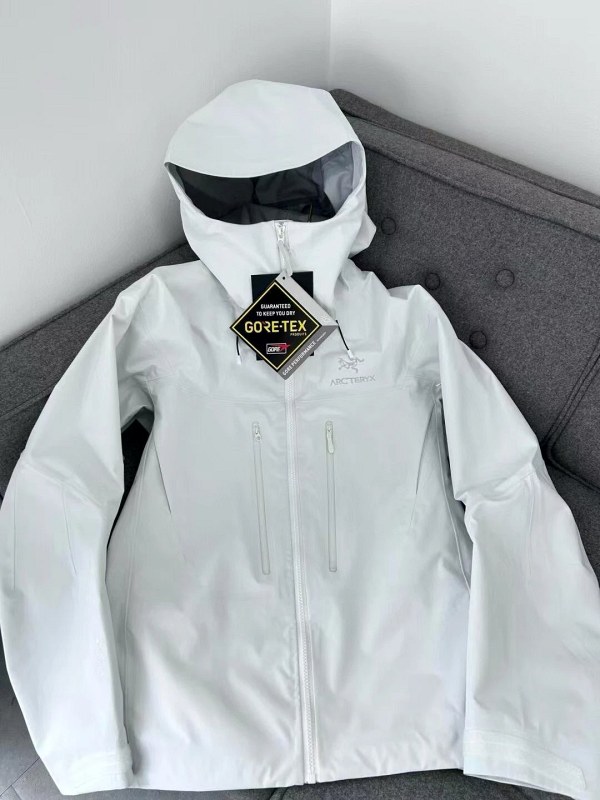
Our testing team bought the Arc'teryx White Waterproof Hard-Shell Jacket (SKU 7702033467) through a shopping agent and paid $137.31 against the listed $154.90. The parcel reached our Rotterdam desk nine days after payment, folded in a plain poly bag with no branded box or hangtag wallet. The listing calls the colorway Polar White and offers S–XXL; we ordered a men's medium, weighed it at 438 g on the calibrated scale, and put it through a full week of Dutch autumn — drizzle, a five-minute shower test and one 30°C wash cycle.
What the listing states, and what it skips
The product page is unusually thin for an outerwear listing. It names the brand, the Polar White colorway, sizes S–XXL, a full-zip front, an attached hood, two vertical chest pockets and a visible GORE-TEX tag at the front zipper. That is essentially the whole record. There are no flat measurements, no fabric or membrane specification, no denier, no claim about seam sealing, and no condition notes.
Two things followed from that. First, we measured the garment ourselves rather than borrowing a size chart. Second, anything the seller has not documented stays an open question in this review, not a settled fact — including what the GORE-TEX tag is actually attached to.
Flat measurements, taken with a tape on a hard table
All figures below are from our size M sample, laid flat and relaxed, measured twice by two people.
| Measurement | Size M, flat | What it means |
| Pit to pit | 58 cm | About 116 cm garment chest — roughly 15 cm of ease over the top of Arc'teryx's published M chest range |
| Shoulder, seam to seam | 48.5 cm | Drops just past the natural shoulder; sits clean over a fleece |
| Sleeve, shoulder to cuff | 65 cm | Ends at the wrist bone on a 178 cm / 73 kg tester |
| Back length, collar base to hem | 74 cm | Covers the seat; brief enough to sit under a harness or pack belt |
| Hem width, flat | 56 cm | No drawcord at the hem on our sample |
| Hood opening, circumference | 60 cm | Fits over a beanie with room to spare |
Arc'teryx's own men's guide says the fit was recently revised — smaller sizes tighter, larger sizes looser — and advises taking the larger size if your measurements fall between two. Owner threads on shell layering broadly agree: buy your usual size for a trim shell, size up if a mid-layer lives underneath. Our medium matched that advice exactly, with enough room for a 200-weight fleece and no excess fabric to gather at the front zip.
Construction: seams, tape, hardware
Under the loupe, the stitching ran even at 12–13 stitches per inch across the shoulder and sleeve seams, with no skipped stitches or loose thread tails. The seam tape inside the body is roughly 13 mm wide, fully bonded and centred over the stitch line; we found no lift at the hood or underarm junctions before or after washing. The two vertical chest pockets use water-resistant reverse-coil zips with small pulls, and the zipper garage at the chin is deep enough that the pull never touched skin. Our sample carries no legible hardware branding on the pulls, so we cannot confirm the supplier — worth asking the agent if that matters to you.
The hood is attached, single-adjustment at the rear, with a stiffened brim that kept drizzle out of our tester's glasses. The high collar closes to the chin and the dark lining, visible at the hood opening, contrasts sharply with the white face fabric. Notably, there are no hand pockets. The two chest pockets are the only storage, which is a real usability call rather than a defect, but it is the first thing to weigh if you expect to walk with your hands in your pockets.
The pour test and seven wet days
Fresh out of the bag, water beaded and ran off the shoulders and sleeves immediately, leaving no dark wet-out patches. We poured 25 ml across the upper back: it sheeted off in under two seconds, and the fabric underneath stayed dry to the touch. Across seven days of Rotterdam drizzle — including two commutes in steady rain and 40 minutes standing in it — the shell kept our base layer dry at the shoulders, chest and hood, and the chest pocket contents stayed dry with the zips closed. Breathability is the harder thing to score in a Dutch autumn; our tester ran warm on a 25-minute cycle ride and found condensation at the back panel, which is typical of a shell worn over a synthetic mid-layer.
One wash, and the white-fabric problem
We washed the jacket at 30°C with a technical liquid detergent, double-rinsed, and tumble-dried on low for 20 minutes to reactivate the finish — the routine GORE-TEX publishes for its outerwear. Beading came back to roughly where it started, and the tape stayed flat. That part was unremarkable in the best way.
The colorway was not. After two days, the cuffs and the inside of the collar had picked up visible grey grime, and the cuff edges needed a dab of diluted dish soap before the wash. Owners of white and other bright Arc'teryx hardshells report the same pattern at much longer intervals, along with yellowing over time and cleaning that is noticeably harder than on dark colorways. Our seven days can't confirm yellowing; they can confirm that Polar White shows everything, immediately.
What a GORE-TEX tag can and cannot prove
The tag at the front zip is real, visible and stitched where the listing says it is. It is also a label, not a laboratory result. We could not verify the laminate's identity, the membrane specification or the waterproof rating from the outside of the garment, and the listing supplies none of those details. If the membrane matters to you — and on a shell it is the entire product — ask the agent for the inner care label, a photo of the membrane-side seam tape, and any stated hydrostatic head before you commit.
We would also flag a category-level caution from owner threads: some Arc'teryx hardshell owners report delamination after comparatively light use. Our sample showed no tape lift after a week and one wash, which is a single data point, not a rebuttal.
Where the $137 lands
As a piece of outerwear, this is a well-cut shell with clean stitching, sound seam tape, a genuinely good hood and beading that survived a wash. As a listing, it is under-documented: no measurements, no membrane detail, no condition record. The price is what makes the trade-off interesting, and the maintenance burden is what makes it a decision rather than a default. Buy it if you want a bright technical shell and are willing to wash it properly and often; measure yourself first, because the seller will not do it for you.