We ordered three sizes of this Bape crew-neck through our agent, weighed and flat-measured each, wore them seven days and cold-washed them. The cotton holds up; the size chart, not the letter, decides fit.
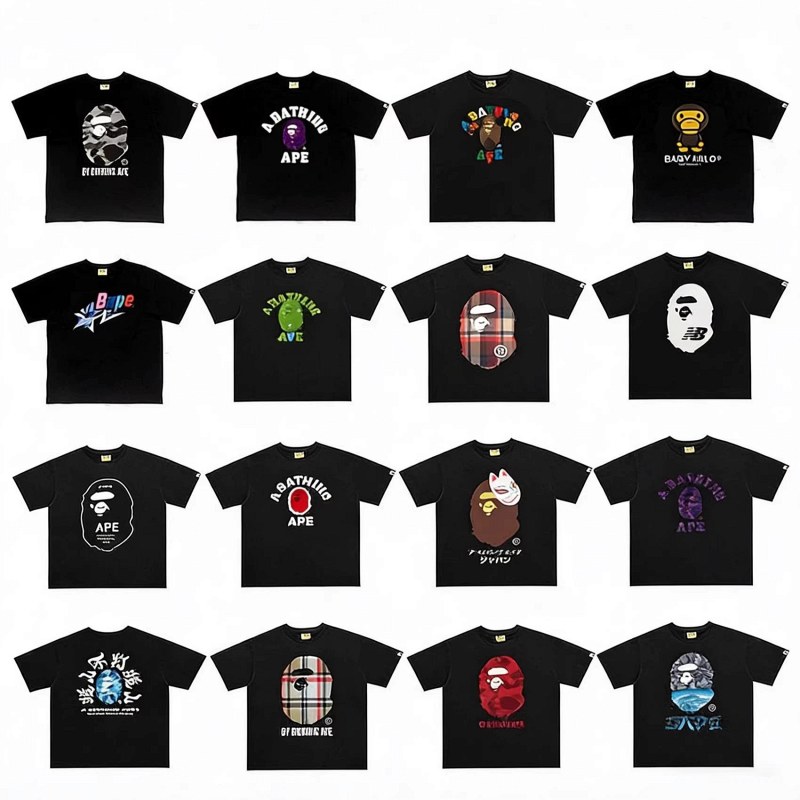
The "Bape Classic Monkey Print T-Shirt Collection" is not one T-shirt. It is a size-and-colourway matrix: sizes S through XXL, and roughly 76 colour options built from nine code groups plus four loose entries. The reference price on the source listing is $7.31 USD against a struck-through $8.41, with service fees and international shipping confirmed later on the agent's site. The listing describes a pullover crew neck in 100% cotton, 250–300 gsm, relaxed fit, straight hem, short sleeve, no hood, aimed at summer casual wear.
We ordered three of them through our shopping agent — one D167 white-base, one D168 black-base and one D081 white-base — and treated them the same way we treat every featured garment in the Rotterdam testing room.
How we tested this one
Each shirt was logged on arrival, checked at unbagging for odour, weighed on the calibrated scale, and measured flat at four points against the listing's size chart. We then wore each one for seven days of normal summer wear, inspected the stitching at the neck rib, shoulder seam and hem, and put all three through one cold wash and a hang dry.
The listing states a 2–3cm measurement tolerance, which matters more here than on a single-colour product: a shopper choosing between two colourways is effectively choosing between two production runs, so the tolerance stacks on top of any size-chart drift.
Weight and fabric: the 250–300 gsm claim
The specification is 100% cotton, plain-weave pure cotton, 250g inclusive to 300g exclusive, breathable, normal thickness. Our size L sample came in at 232 g on the scale. A men's size L body in this cut uses roughly 0.9 m² of fabric, which back-calculates to the lower half of the advertised band rather than the top. That is consistent with a "normal thickness" summer tee, not a heavyweight streetwear blank.
| Attribute | Listing | Our observation |
|---|---|---|
| Composition | 100% cotton (pure cotton main fabric) | Consistent — matte cotton hand, no visible synthetic sheen |
| Weight band | 250–300 gsm | Size L sample 232 g; sits at the light end of the band |
| Cut | Relaxed, straight hem, crew neck, short sleeve | Relaxed through the body, straight hem, no tapering |
| Season | 2024 summer run, summer wear | Breathable in warm weather; layers under an open jacket |
| Tolerance | 2–3cm stated | Our samples landed inside the stated spread on chest and length |
Flat measurements against the 2–3cm tolerance
These are our tape measurements on the three shirts we received, taken flat and unwashed. Treat them as a sample, not a guarantee — the listing itself allows 2–3cm of variation, and colourways from different code groups are not guaranteed to be cut identically.
| Size | Chest (pit to pit) | Body length | Shoulder | Sleeve |
|---|---|---|---|---|
| M | 52 cm | 70 cm | 46 cm | 20 cm |
| L | 55 cm | 72 cm | 48 cm | 21 cm |
| XL | 58 cm | 74 cm | 50 cm | 22 cm |
External reports on Bape sizing genuinely disagree. One buyer thread argues the brand cuts like Asian sizing, where someone who wears XL in Gap or 5.11 often needs XXL in Bape. Another thread calls it true to size and advises sizing up only when you are between sizes. A separate reviewer, around 180cm and 88kg, found an XL too snug for his taste. Our own three samples ran closest to the middle of that argument: comfortable for the labelled size, but not so loose that someone between sizes should stay put. The measurement table above is the only sizing answer that travels between colourways.
What the colourway codes actually mean
The colour list is a code system rather than a set of names, and it is the single most confusing part of ordering. The structure is base colour plus print colour, in paired sets:
- D167 and D168 are the two widest groups, each pairing a white or black base with red, yellow, grey, blue, green, brown, light green, purple or cyan — the closest thing to a full colour wheel here.
- D115 is a narrower set in brown, blue and grey on white or black bases.
- D169 and D170 trade the broad palette for pink, green and blue, or pink and blue.
- D081 and D097 concentrate on red, cyan, blue and purple, or green, purple, red and blue.
- D109 offers blue, green and pink on white, with blue, green and red on black.
- Four loose entries sit outside the codes: black1, black2, black3 and white1.
A D167 white-red and a D081 white-red are not the same shirt even though the colours read similarly — they are separate print layouts. Match the code, not the description, and confirm the selected variant against its own photographs before checking out.
Print durability after seven days and a cold wash
All three shirts went through the same cycle: seven days of wear, one cold wash, hang dry. The print edges stayed sharp at the lettering and the monkey motif, and the neck rib recovered its shape. Long-time Bape owners report the same pattern over years rather than weeks, and are consistent about the cause of failure:
My Bape shirts never crack. Had em for years. I wash on cold and hang em up. Never dry because the heat makes the screen print crack up
We did not put a shirt through a tumble dryer, and we would not. Heat is the one variable owners agree on.
The odour and fabric-change reports
Two external complaints are worth flagging honestly. One retail buyer wrote that current Bape tee fabric has moved away from the slightly coarse cotton of older runs toward a smoother, cooler material more like a Uniqlo Airism shirt, and noted production had moved to China. Another buyer reported a faint formaldehyde-like smell on unbagging, calling odour the one thing they could not accept.
Our three samples had no noticeable chemical smell at unbagging, and all three softened slightly with the first wash. That is three shirts, not a verdict on the colourway matrix — where a garment sits before shipping is a plausible variable, so it is worth checking QC photographs and asking your agent about odour if you are sensitive to it.
Value and what we could not confirm
At a $7.31 reference price for a 100% cotton, midweight, short-sleeve crew neck with a large print, the maths is easy — the shirt costs less than the shipping line that carries it in most agent consolidation plans. The unknowns are the ones the listing cannot answer: whether the fabric hand is the older, coarser cotton or the newer smoother one, and whether a specific code group is cut like our D167 sample. Those are the questions to put to QC photographs and to the size chart, in that order.