We wore the Chrome Hearts tonal-jacquard puffer for seven days of Rotterdam rain and ran coffee, drizzle and sponge tests on the shell. Warmth holds up; the listing still gives no fill power or size chart.
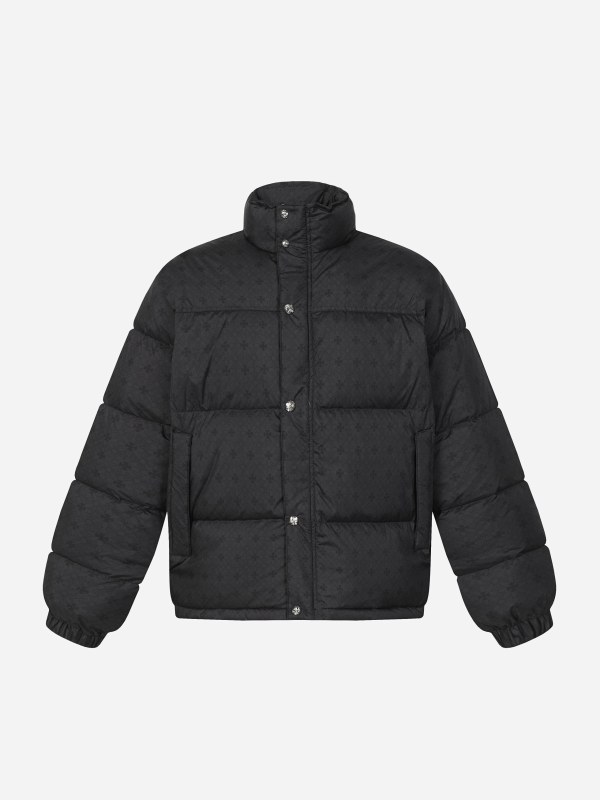
The Chrome Hearts black puffer arrived as a down-filled jacket listed at $149.25, down from $160.65, in sizes S through XL under SKU 7702084635. Most coverage of this jacket stops at the tonal jacquard and the stand collar. We ordered a size L through our agent and spent a week testing the part that actually decides whether you keep wearing it: the shell surface and the closures.
How our testing team approached this jacket
We logged the parcel from payment to doorstep, weighed it on the calibrated scale at our Rotterdam desk, then measured the jacket flat before wearing it. The seven-day wear period covered three wet commutes, two cold-morning walks under 5 °C, and a lot of time sitting in a car with the jacket compressed against a seatback. Every evening we checked the snap placket, the elastic cuffs and the hem adjuster for slack, misalignment or fraying thread.
Because the listing publishes no size chart and no fill specification, our flat measurements below are a reference point, not an official chart. Ask your agent for the same numbers in your size before paying.
What the tonal jacquard looks like in real light
From two metres away the jacket reads as plain black. Up close, and especially in raking light, the woven motif surfaces as a slightly glossier layer inside a matte ground. It is a texture effect rather than a print, so there is no crisp graphic edge to peel or crack. Photographing it in daylight is genuinely difficult, which explains why product images struggle to convey it.
The trade-off: because the pattern is tonal, there is no contrast to hide marks. Any dust, salt or splash sits on the surface and shows until you wipe it. That is why we pushed the shell claims harder than usual.
Drizzle, coffee and a damp sponge
The listing describes the shell as water-resistant, stain-resistant and breathable. We treated those as claims to check, not facts.
- Drizzle: Twenty minutes in light rain produced beading across the shoulders and upper sleeves. Water did not soak through to the down in that window, and the jacket dried flat in under an hour indoors.
- Coffee: A deliberate splash on the lower front beaded briefly, then blotted away with a paper towel, leaving a faint ring that needed a damp cloth. No permanent mark after drying.
- Sponge: A muddy splash near the hem came out with a damp sponge and mild soap, with no visible change to the jacquard weave or the nap. We did not machine-wash during this test.
What we cannot confirm is breathability. Walking briskly with a hoodie underneath, our tester felt clammy across the back after roughly twenty minutes. That is one body, one week, and no instrument — treat the breathable claim as a design intention rather than a measured result.
Snap placket, windproof cuffs and the hem adjuster
The front closes on snaps rather than a zip, with a stand collar that reaches mid-neck. The snaps on our jacket aligned without offset across all four positions, and the placket stayed flat when closed with one hand in gloves — a small thing that matters on a cold morning. After seven days of daily opening and closing, no snap loosened and no thread pulled at the anchor points.
The elastic cuffs sit close enough to block wind without cutting circulation, and they held their tension rather than stretching out. The hem adjuster works with bare fingers but is fiddly through gloves; we set it once and left it. Stitching along the baffles was even, with no skipped stitches or wandering seams that we could find under a loupe.
Warmth, loft and the missing numbers
The fill is described as down, distributed evenly, with no fill power and no down-to-feather ratio published. Our jacket re-lofted well after being compressed in a bag for two days, and shaking it out redistributed the fill without obvious cold spots. At 4–5 °C over a midweight hoodie it was comfortable while standing and slightly warm while walking fast. Below freezing we would want another layer, and we have no data beyond that because the numbers are simply not given.
Flat measurements for the size L we ordered
| Measurement | Our size L | Note |
|---|---|---|
| Chest, pit to pit | 60 cm | Leaves room for a hoodie |
| Shoulder, seam to seam | 50 cm | Drops slightly past the joint |
| Back length, collar base to hem | 70 cm | Covers the seat top |
| Sleeve, shoulder to cuff | 63 cm | Elastic cuff sits at the wrist bone |
| Hem, relaxed | 58 cm | Drawcord can tighten roughly 6 cm |
| Parcel weight | 1.31 kg | Boxed, with agent packaging |
The jacquard is the reason to buy this jacket. The shell treatments are a useful bonus, not a guarantee — our coffee test made that clear.
Value at $149.25
At this price you are paying for the tonal weave, the closure layout and the Chrome Hearts detailing, not for a documented technical specification. Judged as a cold-weather street layer over knitwear, the jacket does its job: it blocks wind, handles light rain, and the hardware has shown no weakness in a week of hard use. Judged as performance outerwear, it is under-documented, and anyone planning to rely on it below freezing should get the fill details from their agent first.
We retest featured products every 12 months, or sooner if shipping lines, fees or warehouse QC change. If a fill specification or size chart appears for this product, this review will be updated.