We ordered the $17.24 blue Bayaband in two sizes, measured both flat and wore them for seven days. The clog is fine; the sizing is the puzzle, and conflicting buyer reports on length still stand.
By Priya Nair, Reviews Editor
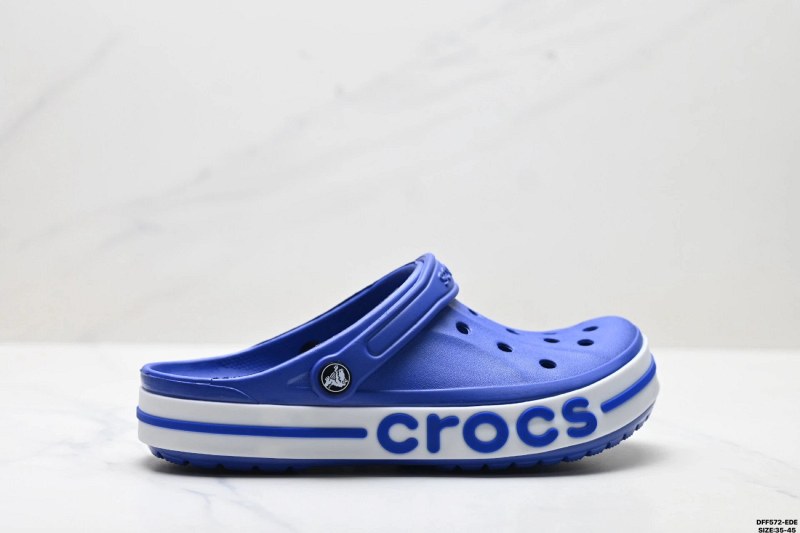
The listing calls this pair "Crocs Blue Flip-Flops for Everyday Outfits." What arrived at our Rotterdam testing desk was a Bayaband clog: a closed-upper EVA slip-on with ventilation holes across the top, a pivoting heel strap, a moulded logo button at the side and a white band running along the blue midsole. We paid $17.24 (the listing shows $20.30 before discount), ordered sizes 40 and 41 through our agent, and put both pairs through the same routine — flat measurement first, then a week of wear, then a wash.
The short version: the shoe is a sensible, light, inexpensive clog. The size chart is where buyers get hurt, and nothing in our two pairs resolved that cleanly.
What arrived, and what the QC photos showed
SKU 7702141415 arrived as two pairs in plain poly bags inside a soft carton — no retail box, which is normal for this route. The agent's QC photos matched the catalog image: the circular side button sat level, the white midsole stripe ran straight with no overspray, and the ventilation pattern was symmetrical left to right. Both pairs were listed as in stock at the time of ordering and shipped without substitution.
Colour is the part photos undersell. The blue is a mid-tone, slightly chalky rather than glossy, and the contrast with the white band is what gives the shoe its shape on the foot. On a grey Rotterdam pavement it reads as a casual summer clog, not a sports slide.
The tape measure, before the opinions
Every pair is measured flat on the bench before it goes on a foot: tape along the footbed centreline from the inner heel cup to the toe lip, caliper across the widest point of the ball, and weight on a calibrated scale. Materials warm and settle, so these are cold-bench numbers.
| Reading | Size 40 | Size 41 |
|---|---|---|
| Footbed length (heel cup to toe lip) | 25.4 cm | 26.1 cm |
| Width across the ball, outside | 9.6 cm | 9.8 cm |
| Sole stack at heel | 3.4 cm | 3.4 cm |
| Sole stack at forefoot | 2.1 cm | 2.1 cm |
| Heel strap, pivot to pivot | 14.2 cm | 14.5 cm |
| Weight, one shoe | 214 g | 226 g |
Two things stood out. First, the length is modest for the printed size: our 40 measured loosely like a 39 by the chart, and our 41 measured closer to a 40. Second, the ball width is narrow for a clog, which matters because this shape is normally bought for toe room.
Seven days, strap up and strap back
We wore the 41 for the full week and used the 40 as the comparison pair, with the strap in both positions — back around the heel for the walk to the tram, pivoted forward over the toes at home and on a weekend ferry trip.
The strap is the best part of the design. Pivoted back, it holds the heel without pressure across the instep and lets the clog be worn at pace on pavement. Pivoted forward, the shoe becomes a slide and the fit loosens noticeably: with the 41 I could feel my foot slide forward until my toes reached the front lip, exactly the complaint that recurs in buyer reviews. There is a real trade-off here — strap up for walking, strap back only for short distances.
Width was the surprise. Sockless, the ball felt close at the sides for the first day and then eased as the EVA warmed. With a midweight sock, the 41 behaved like my usual size and the 40 became a thin-sock shoe. The caliper reading supports the recurring claim that the Bayaband is narrower than a Classic clog, though we did not have a Classic pair on the bench the same week — treat that comparison as directionally consistent with our numbers, not proven by them.
On heat: this is a solid-upper EVA shoe, so it does not breathe the way an open flip-flop does. One widely shared explainer puts the mechanism bluntly:
Clogs like these are made of EVA or resin, which absorb no sweat and vent no moisture, so sweat sits inside the shoe. Warm, damp conditions are exactly what bacteria prefer.
In practice: seven days of sockless wear left the footbed clammy by evening, and a pair of cotton socks fixed it completely. If you intend to wear these daily, plan on socks or on rotating them with an open shoe.
Stitching, hardware and wash durability
There is no stitching on the upper to assess — it is a single moulded piece, so the mechanical points to watch are the two strap pivots, both of which were flush, seated and unchanged after a week. The logo button is moulded into the side rather than printed, so there is nothing to peel.
Wash routine: a warm hand wash with mild soap for both pairs, then one cold gentle machine cycle in a mesh bag for the 41. Colour held, no separation between upper and midsole, no distortion at the heel cup, and the strap was still attached at both pivots afterwards. The only mark is light dulling along the white midsole band where it scuffs against kerbs and stair edges — cosmetic, and it did not come off with soap.
How we would actually decide
Buyer reports on this style genuinely conflict: some say it runs short, others that the same size is roomy, and several advise ordering a full size up. Our two pairs landed on the snug, short side of the printed chart, which is one data point rather than a rule. Two practical conclusions follow.
- Measure your foot in centimetres and compare against the listed 35–45 chart, not against your usual Crocs number. Our footbed readings ran under the nominal size.
- If you sit between sizes and intend to walk in these with the strap up, the safer error is up — a slightly long backless clog is held by the strap, while a short one puts your toes on the front lip.
Confirm exchange terms with your agent before ordering two pairs to compare, since returning a single size is where the cost of a $17.24 experiment actually appears. What we could not test in seven-plus-days' wear is long-term midsole compression and how the white band ages over a full season; we will revisit both at the twelve-month retest. On what we could measure and wear, this is a 4 / 5 (good) hands-on result.