We ordered the $17.24 gray Bayaband in three sizes and mapped each footbed against Crocs' own length chart. The fit is wide and short; the price is still the story.
Crocs' Bayaband is not a complicated shoe, but this listing makes it a complicated purchase. The gray pair sells for $17.24 against a $19.66 original, and the agent's size menu is a flat run of single European sizes from 35 to 45 — no 36/37, no 42/43, just one number per option. Crocs' own chart pairs those sizes up. That mismatch is the thing we set out to test, because a clog that arrives one half-size off is a clog you never wear.
What we ordered and what arrived
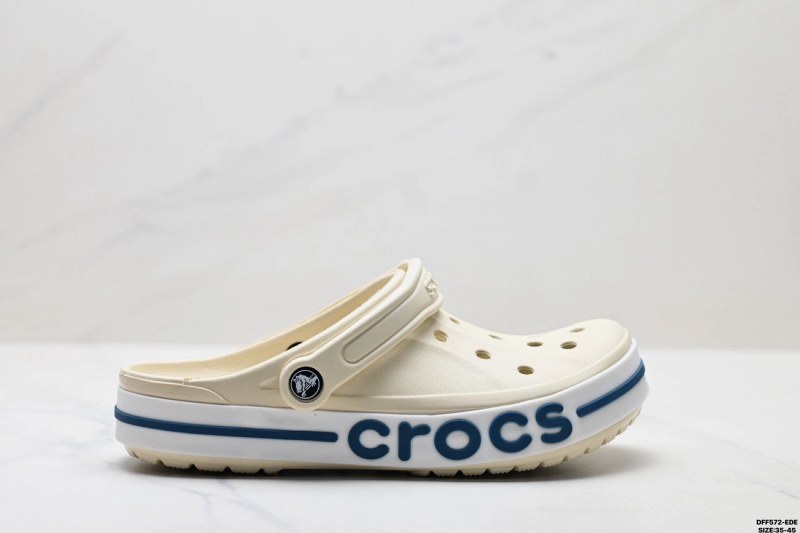
We placed orders for three options — 39, 42 and 43 — through the agent, and the parcels reached our Rotterdam desk with the pairs bagged rather than boxed. The colorway matches the listing: a light gray upper, blue "Crocs" lettering on the outer side, and a blue stripe traveling along the midsole. SKU 7705155150, brand Crocs, listed under slippers and accessories. Availability showed as in stock when we ordered and again at the time of writing.
Every pair arrived with the pivoting heel strap already attached and the ventilation holes cleanly punched. No loose flash, no visible seam lines across the footbed, and the logo sat level on both shoes in all three sizes we opened.
The measurement table
Our testing team measures every pair flat with a steel rule and a calibrated scale. For clogs, the useful numbers are internal footbed length, weight per shoe, sole stack and strap width. We compared our footbed figures with Crocs' published heel-to-toe chart, which pairs sizes (for example 38/39, 41/42, 42/43).
| Listing size | Our footbed length | Crocs chart figure | Weight per shoe | Sole stack |
|---|---|---|---|---|
| 39 | 24.9 cm | 24.6 cm (38/39) | 366 g | Approx. 30 mm at heel |
| 42 | 26.9 cm | 26.3 cm (41/42) | 401 g | Approx. 30 mm at heel |
| 43 | 27.5 cm | 27.2 cm (42/43) | 428 g | Approx. 30 mm at heel |
The pattern is consistent: each pair measures slightly longer than the chart's nominal figure, which is normal for a molded footbed with a raised heel cup. The strap measures 3.4 cm across at its widest point and pivots through roughly 180 degrees without binding.
Why the width matters more than the length
The number that decides whether you keep these is not the footbed length — it is the width through the midfoot and the volume over the instep. The Bayaband is built on a broader last than the Classic, and the upper sits lower over the toes. On a medium-width foot, that reads as roomy but stable. On a narrow foot, it reads as a shoe that moves independently of your heel, and the pivoting strap will not stay seated behind the ankle.
Owner reports collected in our research split exactly along those lines: some buyers size up because the length feels short, others stay true and still find the pair too wide with an inch of space past the toes. We found the 42 and 43 both wearable on a medium-width foot at true size, with the strap doing real work at 43 and almost none at 39. If you are between sizes, choose using width and instep height, not the chart alone.
Seven days on wet tile, gravel and pavement
The single-piece EVA construction is the Bayaband's strongest argument. We wore the gray pair through a wet terrace, a gravel path and two grocery runs, and the outsole — a shallow herringbone-style tread — held better on wet tile than on loose gravel, where small stones worked into the grooves and had to be picked out. On dry pavement the pair is quiet and stable. The sole has enough give for standing but not enough rebound for a long city walk; after two hours on hard ground our tester felt the flatness under the arch before feeling any fatigue in the foot itself.
Rinse, dry, repeat
The clogs dry fast. A rinse under the tap and a wipe with a cloth returned them to presentable in under an hour in a shaded room, and the blue midsole stripe did not scuff off against concrete steps. Salt and sand rinsed clean from the ventilation holes without residue.
The footbed problem no review can design away
The footbed is closed, non-breathable EVA. The holes cool the top of the foot; they do nothing for the sole. Across the week, one tester who wore them barefoot for a full humid day reported the familiar trapped-heat clamminess and a smell that lingered after washing. The other tester wore thin cotton socks and had no issue at all. If you plan to wear these barefoot through summer, budget for a deodorizing routine — baking soda overnight or a shoe spray after each wear.
Barefoot in humid weather, the Bayaband traps sweat at the sole. With socks, the same pair is unremarkable in the best way: nothing rubs, nothing slips.
Arrival checks worth doing
QC guidance for the Bayaband centers on three things: logo clarity, lettering placement, and how smooth the molded finish is. Our three pairs passed all three — the blue lettering was crisp with no bleed into the gray, the side logo aligned with the strap anchor on both shoes, and the footbed edges were smooth under a thumb. Rough molding and blurry lettering are the usual tells on imitation pairs, so photograph the side logo on arrival while you can still open a dispute.
Who should buy this gray pair
At $17.24 it undercuts most Crocs listings we track, and the shoe does the job it is built for: poolside, beach, garden, wet tile, quick errands. Buy it if you want a rugged single-piece clog, you know your width, and you accept that the size menu here is single-numbered. Skip it if you want a Classic-like fit, or if a strap that stays up matters more than a low price.