We ordered the $20.37 Crocs platform Baya in bone white and spent seven days on the least-photographed parts: the back lace, the molded eyelets under it, and how both survive sockless wear and repeated rinsing.
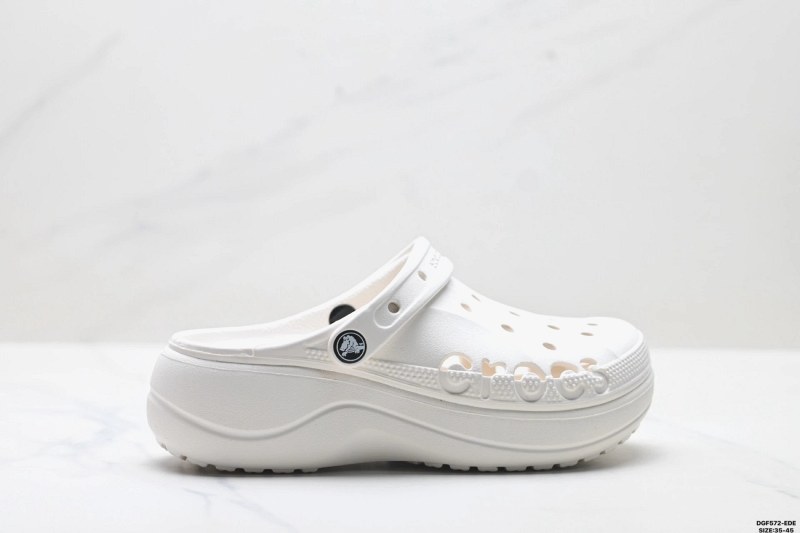
We ordered SKU 7702181915 through a shopping agent for $20.37, with the listing showing $21.81 as the pre-discount price, and the parcel reached Rotterdam in nine days. Our test pair is the platform Baya in bone white, size W7/37, from a women's run that starts at W5/35 and finishes at W9/39-40. Plenty of coverage already exists on how tall this clog is, so we spent our week on the parts nobody photographs: the lace threaded through the back strap, the EVA eyelets it passes through, and how that assembly behaves once it is wet, gritty and worn without socks.
What arrived, and what the tape said
The clog arrived in a plain poly bag with no box, no hangtag and no care slip. The pair was clean, unworn at the footbed, and free of the mold-flash lines that cheap EVA usually shows at the toe cap. We measured the same shoe flat, then again after four days of wear to see whether the molded sole had compressed.
| Check | What the listing states | What we measured on a W7/37 |
|---|---|---|
| Sole height at heel | Platform 3cm or more; mid heel 3–5cm | 34 mm at the heel, 31 mm under the ball of the foot |
| Footbed length | W7/37 within the W5–W9 run | 243 mm heel to toe, inside the strap line |
| Weight per clog | Weight field reads 0.00, so we weighed our own | 268 g on a calibrated scale |
| Upper construction | EVA upper and sole, injection-molded, closed toe | Single molded piece; no seam or join at the toe cap |
| Ventilation | Ventilation holes across the vamp | Twelve oval apertures per shoe, plus one side port behind the emblem |
| Back detail | Heel strap with a lace detail | Flat woven lace, roughly 4 mm wide, knotted at both eyelets |
| Colour | Bone white | Warmer and slightly creamier than the product photo on a grey card |
The back lace is the part to watch
The lace is not decorative trim stitched onto a finished strap. It runs through two molded holes punched directly into the EVA and is knotted on the outside at each end, which means every bit of tension is carried by lace rubbing on foam rather than on a metal eyelet. That is the single construction detail we would expect to fail first, so we tracked it daily.
What held
- Neither knot pulled through its eyelet across seven days, four rinses and one strap-flipped commute.
- The eyelet walls stayed smooth. No burring, no tearing at the hole edge, and no visible enlargement when we re-measured the openings on day seven.
- The strap kept its tension when worn behind the heel, which is unusual at this price — most budget EVA straps go floppy within a week.
What did not
- The knots worked loose twice, once after a brisk walk and once after rinsing. Re-tying is a ten-second job, but check them before you leave the house.
- Flipped forward as a slip-on, the lace ends hang below the sole line and drag on pavement. Ours picked up grit and darkened at the tips within two outings.
- The cut ends of the lace fuzzed slightly by day five. Cosmetic only, and no fraying travelled up the lace.
By hour three my foot was sliding a few millimetres inside the closed toe, and the back strap was the only thing keeping the clog from feeling loose.
Sockless for five of seven days: the muggy-foot notes
Independent clog coverage is blunt about this, and our wear test confirmed it. The twelve vent apertures move water out quickly — a rinsed clog was dry inside in under forty minutes on a balcony — but they do not move air. The EVA body is closed-cell and the heel is enclosed, so heat has nowhere to go. At 24°C, walking and standing for a morning, our tester noticed warmth and a slick footbed at roughly the three-hour mark. By day three the footbed carried a distinct smell that a soapy rinse and full air-dry removed overnight.
Two things helped. First, a daily thirty-second rinse with dish soap and a finger-scrub of the footbed, dried mouth-up rather than towel-dried. Second, wearing a thin cotton sock on the longest day, which traded the slip for a warmer foot. Neither fix makes the clog breathable; they just keep the surface clean enough that odor does not build.
Sizing: our measurement against the printed chart
The footbed on our W7/37 measured 243 mm. That is a normal 37 in absolute terms, but the closed toe and the strap combine to make the wearable length shorter than the number suggests: with the strap engaged behind the heel, the toes sit close to the front wall. Buyers of platform Crocs report the same thing — that platform builds fit more snugly than classic clogs and that going up is the safer move if a standard Croc already fits you. Owners also note that clogs feel tight with socks, where the larger size works better.
Our advice follows from both our tape and that pattern. If you are between sizes, or you plan to wear socks more than occasionally, take the next size up in the W5/35 to W9/39-40 run. If you wear the strap flipped forward and go barefoot, your usual size is workable but will feel close at the toe. Either way, measure your foot flat against a wall and compare against the listing's foot-length chart before ordering, because the sizes here are labelled in both W numbers and EU equivalents and the two do not map cleanly.
Height and grip on wet tile
At 34 mm under the heel, this is a genuine height increase rather than a cosmetic slab, and the extra stack changed how our tester walked on stairs for the first day. On dry tile and pavement the molded tread was secure. On wet smooth tile after a rain shower, the same tread slid noticeably during a deliberate turn, and the platform magnifies that because there is more lever under the ankle. That matches the standing complaints about EVA clogs generally — slippery footing on wet smooth surfaces, and insufficient arch support over long distances. We would not wear these as a rain shoe or on wet polished floors.
Finish after a week of washing
We rinsed on days one, three, five and seven, with a full soak on day four. The bone-white finish held without yellowing or grey shadowing at the flex lines, which is the usual failure mode for cheap white EVA. Scuffing appeared on the outer edge of the left sole and along the strap's outer face, and most of it came off with a thumb and soap. The emblem on the side is molded in, not glued, so there is no lifting edge to catch. At $20.37 and listed as in stock, the finish is the strongest argument for the pair; the fit and the airflow are the arguments against.