We bought the $34.48 purple Onitsuka Tiger low-profile sneaker, measured the EU 42 flat, and wore it for seven days. Light, flexible and true to size, but wet-weather grip and a thin-heel break-in are real costs.
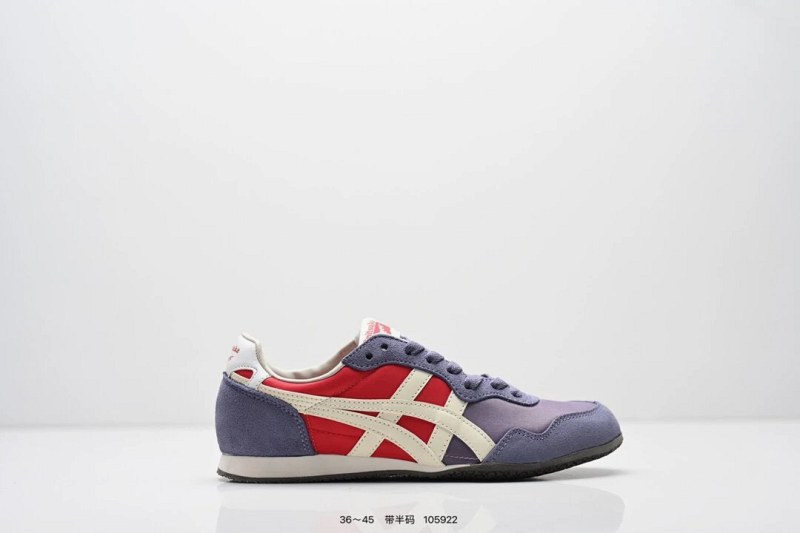
We ordered the purple Onitsuka Tiger low-profile sneaker through a shopping agent for $34.48, down from a listed $39.99, in EU 42. Our testing team then measured it flat against the agent's size chart and wore it for seven consecutive days on Rotterdam pavement, tram floors and wet paving slabs. The listing title says Mexico 66; the feature block further down the same page describes the Serrano and quotes item number 1183B400-407. Both names point at the same idea — a thin, flat, low-profile retro trainer — so we tested the pair that arrived and treated the listing copy as a claim to be checked rather than a specification.
What arrived in the box
The parcel contained one pair, wrapped in tissue, with no spare laces and no branded dust bag. The upper is a leather-and-synthetic mix with a genuine leather lining, and the collar is padded only lightly. Underfoot there is a thin glued-in EVA insole, an EVA midsole that the listing says includes Solyte, and a shallow-tread rubber outsole. The details that define the look are all present: cream side stripes, red accents at the heel and eyestay, and the slightly upturned front that gives the shoe its 1960s athletics profile.
Colour is the one thing photographs cannot settle. Under daylight the purple reads as a mid-tone grape with a matte finish; indoors, under warm light, it darkens several shades toward aubergine. If you are matching the shoe to an existing purple top, ask the agent for a photo in neutral light before you pay.
Measurements on the desk
We measured the EU 42 pair flat with a tape and calipers, then compared the readings with the agent's chart, which lists EU 42 at roughly 26.5 cm of foot length.
| Check | Our reading (EU 42) |
|---|---|
| Internal length, heel to toe | 268 mm |
| Footbed width at the ball | 96 mm |
| Heel stack | 22 mm |
| Forefoot stack | 13 mm |
| Toe spring (lift at the tip) | 8 mm |
| Pair weight | 566 g |
| Upper thickness at the vamp | 1.6 mm |
The internal length came in about 3 mm over the chart figure, which is inside normal tolerance and consistent with the true-to-size reports we found from owners. The 96 mm ball width is the number to watch. This is a tapered last, and the shoe does not gain meaningful width as the size goes up — it only gains length.
The seven-day break-in, logged
This is where the review earns its keep, because the first 72 hours are not the comfortable part.
- Day 1: Stiff through the toe box, with a clean flex point behind the ball. Heel rub started on the left foot after about four kilometres.
- Day 2: Two small hot spots on the left heel, from a heel lining that is noticeably thin at the collar seam. Creasing appeared across the vamp.
- Day 3: The leather began to give around the flex point; the rub eased enough to walk the same route without a plaster.
- Day 4: Noticeably softer through the vamp. No new rubbing on either foot.
- Day 5: The hot spots were gone. This matches the three-to-five-day break-in reported for the full-leather version of this shape.
- Day 6–7: Creasing settled into two clean folds rather than a collapsed toe box. Outsole wear was limited to hairline scuffs on the heel edge.
Two caveats. Leather of this type typically stretches a few percent over the first month, and seven days is not long enough for us to confirm that figure on this pair. And because the heel lining is thin, wide-heeled wearers should expect more friction than we logged, not less.
Walking on it
The shoe is genuinely low to the ground and bends easily under the ball, which makes the first few hundred metres feel fast and light. The Solyte and EVA midsole is springier than a 22 mm heel stack has any right to be — the ride is soft rather than firm, and the 8 mm toe spring rolls the foot forward without any rocker geometry to speak of. For short city days, station transfers and standing around, this is a pleasant shoe.
It is not a walking shoe in the support sense. There is no arch structure in the glued-in insole, and the forefoot stack is thin enough that you feel individual paving stones. We would not plan a full-day museum route in it without adding a slim, arch-supporting insole, which is also the advice we found from long-term owners of this retro sole.
Wet paving, and the grip problem
The listing itself flags buyer feedback that the rubber outsole is not very slip-resistant, and our seven days agree.
On damp paving slabs the outsole broke away twice in the first ten minutes of the first wet walk — both times on a smooth, glazed surface near a tram stop. We shortened our stride and stayed on rougher asphalt for the rest of the week.
On dry concrete and indoors the tread is fine, and 22 mm of stack keeps the foot close enough to the ground that a slip is easy to catch. Treat rain as a reason to choose a different pair, not as a test of nerve.
The name on the listing versus the name on the shoe
Our pair arrived with no printed model code on the tongue, and the box carried only the agent's own SKU, 7702141515. So the title-versus-spec conflict stays open in our hands: the headline says Mexico 66, the feature block describes the Serrano, and the size line says 36–45 including half sizes while the specification line lists 35–45. Before ordering, ask the agent to confirm the model, the item number and the size run in writing, and check the QC photos for the tongue label and the side-stripe spacing. That is a five-minute request that removes most of the uncertainty.
How it styles
The cream stripes and red accents are the reason this colourway works. The purple base is strong enough to be the loudest thing in an outfit, so we kept the rest neutral: raw denim, grey track pants, a plain white tee. The low profile keeps the shoe visually small under wide-leg trousers, and the cream stripe gives you an easy second colour to echo in a cap or a tote. It looks wrong with nothing we tried — but it is a casual shoe, and it will look out of place with tailoring.
Care, and what seven days cannot tell you
Wipe the leather lining and upper with a damp cloth and let the pair air-dry away from heat; do not machine wash it. The leather will darken slightly at the creases with handling, which is normal. Beyond that, the outsole's long-term wear and the durability of the glued midsole are still open questions for us — a week of walking is not a lifespan test.