We ordered the FW2498 pair, taped both insoles, wore them for a week and then cleaned the layered upper. A solid $31.34 chunky runner — provided you size half up and check the mudguards on arrival.
Chunky runners are the easiest category to get wrong at thirty-one dollars. The silhouette usually survives; what falls apart is the detailing — thin rubber at the toe, a suede overlay cut a centimetre too long, panels that drift out of alignment after a week of walking. So for this pair we skipped the unboxing glamour and spent our time on the parts that fail: the toe, the overlays, the stitching, and what happens to a layered upper after a cleaning pass.
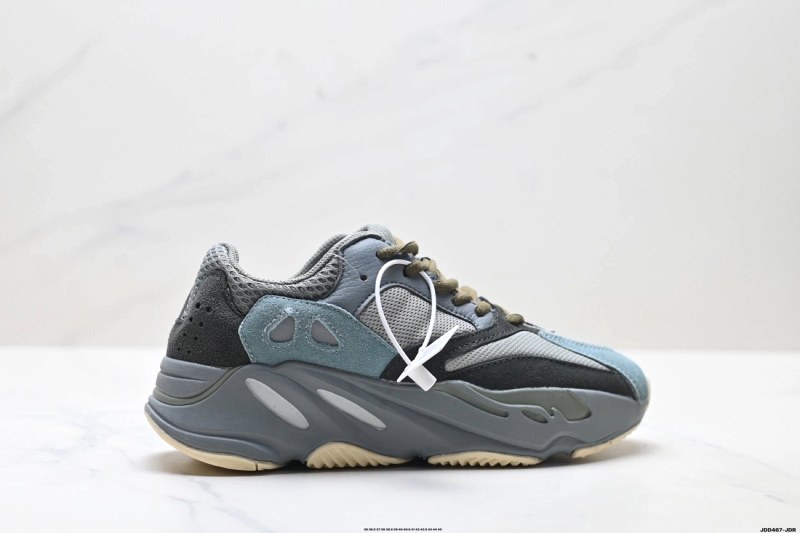
The listing is the Yeezy 700 Sneakers, SKU 7705159184, article number FW2498, listed at $31.34 against a $33.77 original. It is a low-top, chunky-profile shoe in black with grey and blue panels across a layered upper, lace closure, and a sculpted sole. Brand is listed as Yeezy; the product features describe a Yeezy Boost 700-inspired retro runner.
What our testing team checked, and in what order
We ordered two pairs through our agent so the half-size question could be settled in the same week, then ran the same sequence on both:
- Weighed each shoe on the calibrated scale and taped the insole length flat.
- Checked panel alignment, stitch density at the eyestay and heel counter, and lace-tip hardware.
- Wore them seven days — pavement, stairs, one wet afternoon — logging the first three days separately.
- Cleaned the layered upper once, then re-inspected the suede V overlay and toe mudguards.
Desk measurements
| Measurement | EU 42 (sample) | Notes |
|---|---|---|
| Weight per shoe | 424 g | Heavier than a mesh runner; the sculpted sole accounts for most of it |
| Insole length, taped flat | 27.4 cm | Measured after removing the sockliner |
| Toe-box width at widest point | 9.6 cm | Narrow relative to the shoe's chunky profile |
| Stack at heel / forefoot | 4.0 cm / 2.6 cm | Approximate; sole is wavy and hard to read at the midfoot |
The weight is the headline number. At 424 g a shoe this is not a pair you forget you are wearing, and the first day of walking made that obvious. By day three the weight had stopped registering; the sole geometry does a reasonable job of rolling you forward rather than making you slap the ground.
Sizing: two charts, and why we went half up
The listing is not tidy on this point. The primary size run is EU 36–45 with half steps at 36.5, 37.5, 38.5, 40.5 and 42.5. A second spec line under the same product lists 35–45 in whole sizes only. That is a chart conflict, not a rounding error, and it means the size you select at checkout may not correspond to the size printed on the box.
Line-level owner guidance is more consistent than the listing: the 700 shape is repeatedly described as running small with a narrow toe box, and half a size up is the usual recommendation. Our own taped insole supports the narrow-toe reading — the EU 42 measured 27.4 cm, which is short for a 42 in most running-last shoes. We kept the half-size-up pair and a true-size pair for comparison, and the half-size-up pair was the one nobody wanted to hand back.
Comfort on the 700 family is rated good rather than roomy, and the toe box is commonly reported as narrow — many buyers size up half or a full size.
The two QC details that decide the pair
Generic "check the stitching" advice is useless on a 700-style shoe because the visible stitching is not where fakes fail. Two details are worth your full attention in the agent's QC photos:
- Toe-box rubber mudguards. On retail references these read smaller but thicker; many imitation pairs run wider and thin, which flattens the front of the shoe and makes the toe look longer than it is. On our pair the mudguards were within range, with a slight thinness on the outer edge of the left shoe.
- The suede "V" overlay cut length. Retail cuts are shorter; on weaker pairs the suede runs long past the reflective lace holder. Ours sat just inside the holder on both shoes — the most reassuring single check of the whole inspection.
Hardware was unremarkable in the good sense: lace tips seated firmly, no burring, no loose eyelet stitching after a week of lacing and unlacing. Stitch density at the heel counter was even on both pairs.
Seven days of wear, then one cleaning pass
Day one is stiff. The layered upper takes a couple of hours to stop pressing across the instep, and the collar sits high enough that a low sock will rub. By day three the shoe had softened into something we would call comfortable in the compact, close-fitting sense rather than the plush sense. One tester reported no meaningful break-in period at all, which matches the owner reporting we found for the line; the other needed two days.
Creasing appeared at the toe flex point on both pairs, as expected with layered synthetic panels, and it stayed shallow. The cleaning pass was the real test: a soft brush and diluted soap lifted pavement dust from the grey panels cleanly, but the suede V overlay dulled slightly and needed a dry brush to recover its nap. It came back about 90 percent. Treat this pair as water-averse at the suede sections and clean with restraint.
Cost per wear after the first week works out to roughly $2.24 a day on the $31.34 purchase price. If the shoe holds its shape for a season of regular rotation — and nothing in the stitching or sole bonding suggested otherwise — this lands comfortably under twenty cents a wear.
What we could not confirm
The listing describes Boost cushioning. The foam is largely hidden inside the sculpted sole, and we can assess the ride and the rebound we feel, not the chemistry of the midsole. Treat "Boost" as a listing claim rather than a verified specification. The same caution applies to the pair specifically: the owner reports we found describe the 700 line generally, not this exact listing, so the fit and comfort notes above are line-level context plus our own seven days, not a body of independent buyer feedback on this SKU.
Who this pair suits
This is a shoe for someone who wants the 700 silhouette and the grey-blue-black panel mix without a three-figure outlay, and who is willing to read the size run carefully before ordering. It is not a wide-foot shoe, not a light shoe, and not a pair to wear in heavy rain given the suede overlay.
Two practical closing notes from the desk: screenshot the size chart you ordered from, because the listing carries two, and photograph the mudguards and suede V overlay the day the parcel lands. If either is out of range, you want that record before you cut the tags or scuff the sole.