Balenciaga Track 3.0 QC: Panels, Heel and Lettering
By Marcus Feld Editor-in-Chief
| Published | |
|---|---|
| Updated |
The key QC points for this gray Balenciaga Track 3.0 aren't just the overall colorway—it's about verifying the shoe upper panels, reflective panels, heel structure, and toe lettering one by one. Existing product information includes catalog claims, community comparison clues, and buyer feedback, with varying strength of evidence. So before ordering, you should treat "page info" and "specific shoe QC photos" separately. 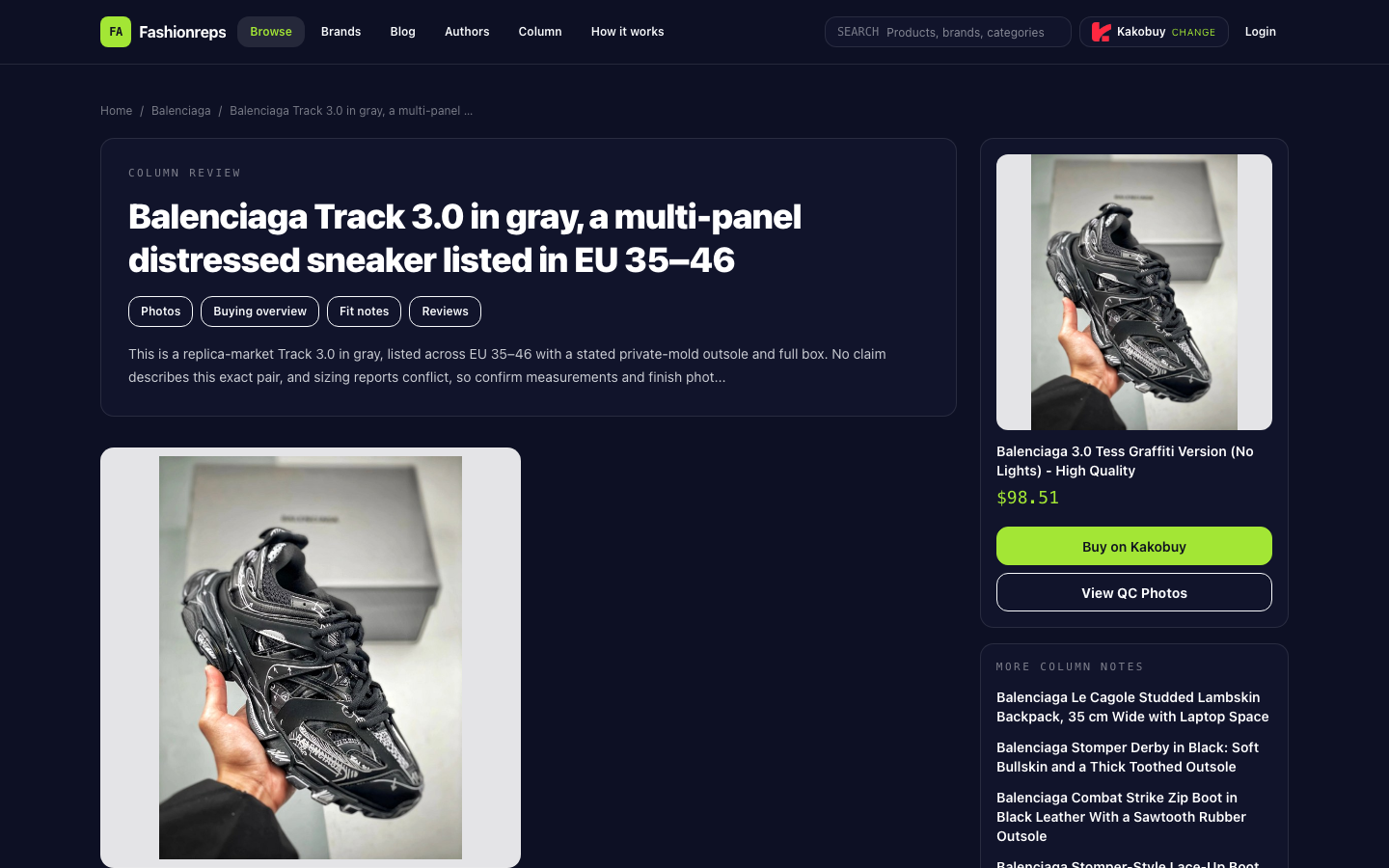
Editor score 4.2 / 5
The key QC points for this gray Balenciaga Track 3.0 aren't just the overall colorway—it's about verifying the shoe upper panels, reflective panels, heel structure, and toe lettering one by one. Existing product information includes catalog claims, community comparison clues, and buyer feedback, with varying strength of evidence. So before ordering, you should treat "page info" and "specific shoe QC photos" separately.

Figure: Illustration of product page info and QC check topics, not representing actual QC evidence for any specific pair pending shipment.
First, confirm what the product page says
The product page describes this as a gray Track 3.0 with multiple panels and a distressed effect, in sizes EU 35–46. The catalog also claims a private mold combination outsole and full box packaging. These are claims in the product listing and cannot replace the seller's real photos confirming the specific stock shoe.
The page shows a reference price of $98.51, with an original reference price of $109.12. Final item amount, service fees, and international shipping must be confirmed by the shopping agent platform; you can't calculate total cost based solely on the product page reference price. Existing materials also don't provide stock status to rely on.
Four areas most worth requesting additional photos
1. Reflective panel width and position
Community comparison clues mention that some Track 3.0 versions may have narrower strip-like reflective panels instead of wider rectangular ones. After receiving QC photos, ask the seller to provide close-ups of the outer sides of both left and right shoes, observing the width, clean edges, and position relative to surrounding upper panels.
Don't just look at distant shots. The distressed effect and complex paneling make reflective areas hard to judge in low-res photos. Request natural light side-profile photos, keeping both shoes in frame to check for obvious asymmetry.
2. Heel tab and V-shaped heel
Existing comparison materials list narrow heel tabs and narrow V-shaped heel structures as points to watch. QC photos should cover the heel front, left and right rear angles, and top tab—not just sole or box photos.
When checking, focus on three things: consistent tab width, flat attachment to the heel, and a roughly symmetrical V-shaped heel outline. If photos are too low angle or the heel is blocked by shoe trees or packaging, ask for more photos before deciding.
3. Toe lettering coverage
Materials mention that the toe lettering coverage may differ from reference: one clue suggests about half the lettering is covered, while another reference shows about one-third covered. This description is only an external check clue, not proof of authenticity or quality level.
Request a top-down close-up of the toe with the upper in natural state, avoiding over-stretched shoe trees that distort lettering position. Both shoes should be photographed; a single photo can't show significant differences.
4. Sole color and glue marks
One Track buyer feedback mentions an all-white pair had glue marks near logos, dark marks on the rear, and the sole arrived off-white instead of pure white. That feedback pertains to a different specific shoe and pair, so you can't assume the same issues for this gray pair, but you can turn it into QC checks.
Ask the seller to photograph the sole forefoot, heel, areas around upper logos, and outer heel. Distinguish between normal distressing, lighting color shifts, and obvious stains or glue residue. If sole color varies greatly across photos, request natural light with a white reference.
How to judge upper panels and distressing
The Track 3.0 upper has many independent panels, and gray shading and distressing may have individual variations. So slight color depth differences aren't automatically defects, and you can't demand a specific pair exactly replicate a promo image just because it looks more uniform.
More valuable checks: Look for obvious misalignment between panels, large glue overflow at edges, unnatural breaks in stitching or bonding, and consistent main structure between shoes. For distressing, prioritize whether it affects upper structure, logo areas, or wearability, not just matching every shadow exactly.
Community materials also describe Track 3.0 as the lighter, lower-priced generation among the three Track versions, noting early leather panels were removed and overall feel is thinner. This is generational comparison, not a measurement of any single pair. If you specifically want a thicker leather panel structure, confirm you're buying Track 3.0, not expecting Track 1.0 or 2.0 construction.
Don't decide sizing based on one conclusion
Existing sizing info conflicts: one Chinese discussion suggests 3.0 runs about a full size large; the Track series guide says overall slightly large, usually go half size down; some Track buyer feedback says true to size.
Thus, this shoe isn't suitable for deciding solely on "runs large" or "true to size." Before ordering, request the specific insole length or internal length from the seller and compare it to your own comfortable shoes' actual measurements. Best to measure a pair of comfortable sneakers, not just foot length or brand size charts.
If the seller can't provide measurements or only sends a vague size chart, sizing risk remains. For those with special foot shape, sock thickness, or fit preferences, don't treat a single community wear feedback as a guarantee.
QC checklist to use before ordering
- Confirm the product page shows gray Track 3.0, not another Track generation.
- Confirm seller provides close-ups of outer reflective panels on both shoes.
- Check reflective panel width, position, and left-right consistency.
- Request photos of heel tab, V-shaped heel, and attachment points.
- Request top-down close-up of toe lettering to verify coverage and left-right differences.
- Check panel edges, areas around logos, and heel for obvious glue marks or dark spots.
- Request photos of sole forefoot and heel, noting if color deviates significantly from page expectations.
- Request specific insole or internal length measurements; don't rely solely on "true to size" or "runs large" descriptions.
- Confirm packaging, service fees, international shipping, and purchase availability with the shopping agent platform's final page.
Should you buy or skip?
If you want the silhouette of the gray Track 3.0, can accept slight individual variations in distressing, and are willing to verify reflective panels, heel, and toe lettering before payment, then this can go on your further confirmation list—provided the seller can supply clear product-level QC photos and size data.
If you need sizing certainty without communication, or expect the product page itself to prove every detail, existing evidence isn't enough for a confident order. If you really want Track 1.0 or Track 2.0 leather panel construction, skip this instead of hoping QC photos will bridge generational differences.
Final judgment should be based on real photos, measurements, and cost confirmation of the specific stock shoe. Catalog claims of private mold outsole, full box packaging, size range, and reference price only describe how the page presents the item; they cannot replace verification of actual details and order terms.