Cartier Belt Review: Size, Hardware and Fit Checks
By Marcus Feld Editor-in-Chief
| Published | |
|---|---|
| Updated |
Before buying a belt with Cartier-style elements, the most important thing is not to first judge whether it "looks like" the real thing, but to confirm whether this product can actually meet your size, wearing scenario, and quality expectations. This article applies to people who are preparing to filter products through the fashion-reps related shopping process but have not yet completed an order. It focuses on helping you accomplish three things: confir
Editor score 4.2 / 5
Before buying a belt with Cartier-style elements, the most important thing is not to first judge whether it "looks like" the real thing, but to confirm whether this product can actually meet your size, wearing scenario, and quality expectations. This article applies to people who are preparing to filter products through the fashion-reps related shopping process but have not yet completed an order. It focuses on helping you accomplish three things: confirm whether the size is usable, organize evidence about the hardware and workmanship, and determine whether it suits smart-casual office wear, jeans, or outerwear styling.
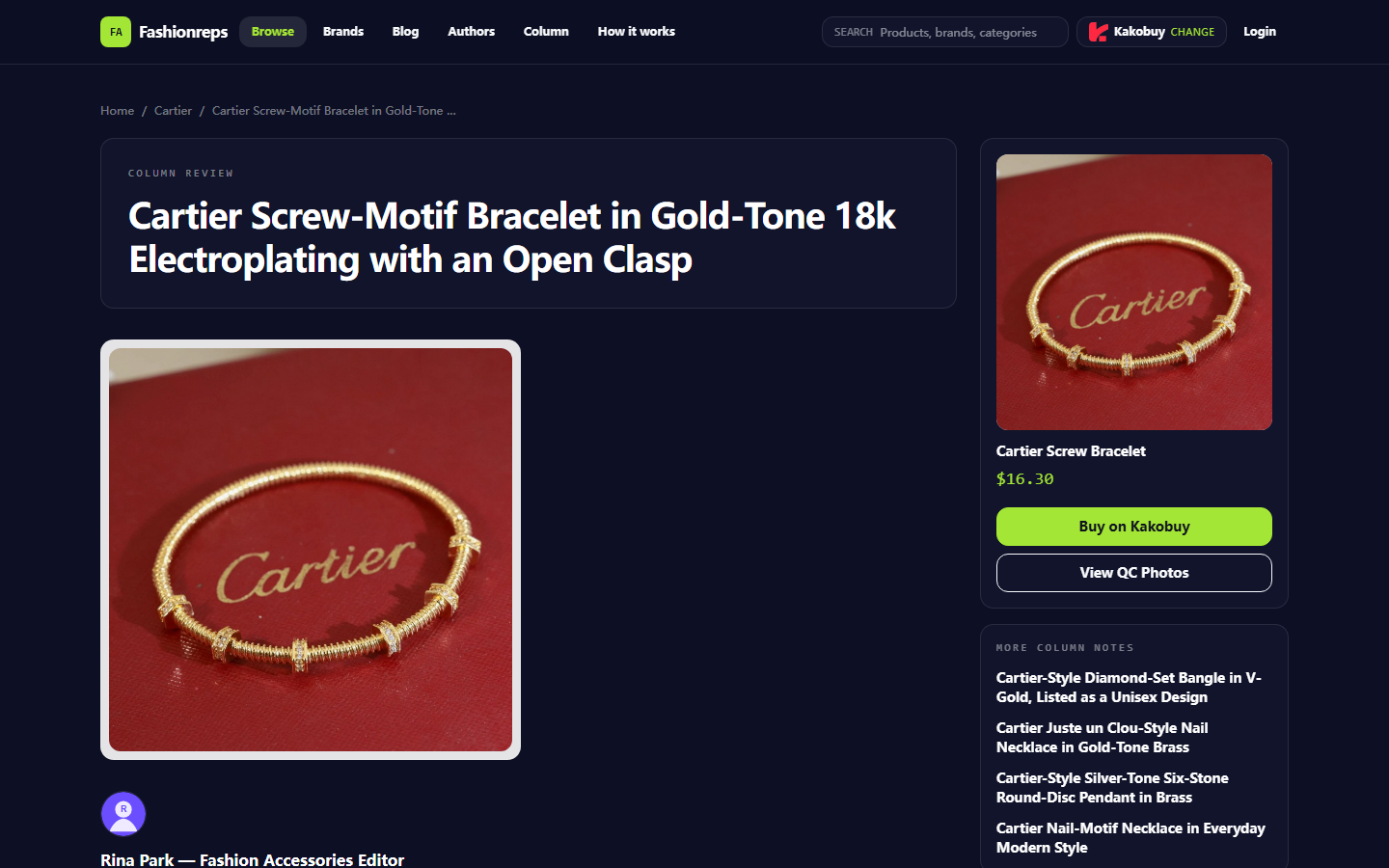
Currently the visible reference material is a Cartier screw-motif bracelet, not a belt. The product name, price, and structure information shown on that page cannot directly prove any belt's size, material, stock, or durability. Therefore, below we will separate the information that can be confirmed from the information that must be verified by rechecking the product page or asking the seller. Anything involving the current item status should be based on the product page reopened at the time of purchase. 🔎
Clarifying the size and fit issues to resolve before buying a cartier belt
The first assessment of a belt is not the brand logo, but whether it can actually land on the right hole when worn. If the product page only writes S, M, L, or only gives a waist range without specifying the measurement position, you cannot directly judge whether it fits your pants and wearing style.
Before purchasing, you should record three sets of measurements:
- The waist circumference you actually use, not the circumference at the narrowest part of your body.
- The position of the waistband where you plan to wear the belt, such as high-waisted pants, mid-rise jeans, or outside a jacket.
- The length from your usual hole to the edge of the buckle pin, ideally recording both the tightest and loosest results.
If you are wearing the belt through the belt loops of jeans, measure while wearing the pants you most often pair it with, using a soft tape measure along the belt loop position. If you plan to wear the belt outside a jacket, put on the jacket before measuring. These two usage styles differ significantly, so you cannot use a single number to cover all scenarios.
The product page should provide at least the following information:
- Total length or adjustable length range
- Belt width
- Number of holes and hole spacing
- Buckle size and pin structure
- Whether the buckle can be replaced or the belt shortened
- Whether the measurement starts from the belt tip, buckle pin, or middle hole
If the page lacks this data, the safest approach is to hold off on ordering and first request actual measurement photos or written specifications. 📏
Verifying specific belt style, color, size, and current link on fashion-reps.net
When verifying, first confirm that the page is indeed a belt, and not mistaking other accessories from the same brand, style, or search results for the target item. The current reference shows a bracelet with gold tone, 18k plating, screw motif, and open clasp, with a reference price of 16.30 USD; the page also states that the final item price, service fee, and international shipping need to be confirmed on the website of the selected shopping agent. This information can only serve as a record for that bracelet page and cannot be transferred to a belt.
Therefore, for a belt page, you should screenshot or record each of the following:
| Verification item | Content to confirm | Handling when missing |
|---|---|---|
| Product identity | Clearly states belt, style, color, and buckle type | Do not use accessory pages as belt evidence |
| Size | Total length, applicable waist, holes, and width | Request supplementary measured data from seller |
| Current status | Whether page is accessible, has stock or can be ordered | Reopen page before judging |
| Price | Item price, service fee, international shipping, and possible taxes | Do not treat reference price as final landed cost |
| Images | Front, back, buckle, edges, holes, and logo position | Request clear close-ups, avoid relying only on promotional images |
If the product page redirects, shows blank, cannot be opened, or only has category tags without clear product information, it cannot be considered valid product evidence. Color names should also be based on the current options on the page, and you should not infer black, brown, gold, or silver from thumbnails.

The displayed reference shows a Cartier screw-motif bracelet page, not an actual belt, so it cannot be used to confirm a belt's width, length, holes, or styling effect.
How to record belt width, length, holes, and buckle information item by item
Belt width directly affects how it passes through belt loops, visual proportion, and outerwear styling. Narrow styles are usually easier to fit with different pants, while wide styles may stand out more but are also more likely to interfere with narrower belt loops. Without an actual measured width, you should not judge solely from product thumbnails.
It is recommended to create a simple record:
- Belt strap width: record in millimeters or centimeters, avoid vague descriptions like "narrow" or "standard."
- Belt strap total length: note whether the buckle is included.
- Usable length: record separately from the pin's fixed point to the outermost usable hole.
- Hole spacing: confirm whether it is even, and whether your most used hole is in the middle of the length.
- Buckle size: record horizontal, vertical, and thickness to judge whether it will press on belt loops.
- Buckle attachment structure: confirm whether it is sewn, riveted, screwed, or detachable.
For styles with prominent decorative buckles or logo elements, also check whether the weight and thickness will cause the belt front to droop. A visually striking buckle is not necessarily suitable for daily office wear, especially when sitting, driving, or wearing a jacket, as protruding structures may cause pressure or snagging.
If the belt needs to be shortened, first confirm whether the buckle can be safely removed and whether it can be reattached after cutting. Without verifiable structure, do not assume any belt can be shortened. ✂️
How to organize visible evidence of hardware, edges, stitching, and logo placement
Pre-purchase assessment can only judge appearance consistency based on visible page evidence; you cannot write photo observations as if you have touched the material or tested durability. Focus on visible, comparable details.
For hardware, check:
- Whether surface color is uniform, with no obvious color difference or localized dullness.
- Whether the pin and loop connection is centered, with no obvious skew.
- Whether screws, rivets, or decorative parts are loose, raised, or inconsistent in position.
- Whether edges have obvious burrs, dents, or unfinished cuts.
- Whether logo and decorative placement is symmetrical left-right and stable distance from edges.
For the strap, check:
- Whether stitching is continuous and stitch length roughly even.
- Whether there is cracking, flattening, or fraying around holes.
- Whether edge paint or edge coating covers completely, and whether there is buildup at corners.
- Whether the strap has obvious creases, dents, or unnatural waves.
- Whether colors at different angles in photos are consistent, or affected by lighting.
These items can help you spot obvious appearance risks, but cannot prove leather grade, internal structure, long-term bending resistance, or authenticity. When the page does not provide independently verifiable material tests, usage records, or durability tests, conclusions should remain conservative. 🧵
What conditions to compare for smart-casual office wear, jeans, and outerwear styling
Smart-casual office scenarios place more emphasis on understated, stable, and not affecting sitting posture. If the buckle is large, highly reflective, or decorative elements are too concentrated, it may be more suitable for occasional styling rather than daily use. Before choosing, compare buckle height, belt width, and the belt loop width of your regular pants.
Jeans usually can accommodate more prominent belt structures, but also watch whether the metal buckle creates too much visual conflict with waistband rivets, zippers, or other metal parts. Dark jeans suit buckles with strong contrast, while light-colored or slim-fit jeans more easily expose issues like uneven belt edges, deformed holes, or excessively thick straps.
Outerwear styling requires extra consideration for stability. If the belt is worn outside a jacket, the strap length should accommodate the actual layering thickness, and the buckle should not be flipped forward due to thicker fabric. Thick knits, down, or structured blazers may yield different measurements than ordinary pants, so don't rely only on bare waist data.
You can make styling judgments in this order:
- First confirm the belt can pass through the target pants or jacket attachment points.
- Then confirm the buckle size will not press, snag, or affect sitting posture.
- Finally judge whether the color, shine, and logo elements suit your daily wardrobe.
If only one specific outfit works and other regular clothes don't fit, you should not treat it as a general-purpose belt purchase. 👖
What product pages cannot prove about leather, durability, authenticity, and actual comfort
Product page images usually help observe appearance, but alone cannot prove the following:
- Whether the leather is the material claimed on the page.
- How long the surface treatment will last.
- How many times the buckle will remain stable after opening and closing.
- Whether the strap will crack or deform from bending.
- Whether it is comfortable when worn, or whether it will catch clothes or chafe skin.
- Whether the item is authentic or has any brand authorization.
The bracelet page in the reference states it has a gold tone, 18k plated surface, and base alloy, and warns that the plating may wear with prolonged use; the page does not provide plating thickness. This information can only be used to understand that plated jewelry requires attention to surface durability, and cannot infer any belt's material or lifespan.
Similarly, do not use conclusions like "genuine," "authentic," "guaranteed," or "durable" just because the product name contains the brand name. A safer recording method is to distinguish three states: information clearly stated on the page, phenomena visible in images, and matters not currently provable. This helps avoid overpromising and makes it easier to ask the seller specific questions later.
Checklist for QC photos and supplementary specification requests
If the product page already provides QC photos, prioritize confirming whether the photos are from the target style and check if they cover the following angles:
- Full belt front and back
- Buckle front, side, and connection area
- Belt tail, holes, and edges
- Close-ups of logo, decorative parts, or screws
- Bending areas and stress points
- Size ruler or reference objects for scale judgment
If existing images are insufficient, you can request supplementary information from the seller or shopping agent:
- Please provide actual measurement photos of belt width and total length.
- Please specify whether the length includes the buckle and where measurement starts.
- Please provide the distance from the most used hole to the buckle pin position.
- Please photograph the buckle side to confirm thickness and attachment structure.
- Please confirm color options, currently available sizes, and whether QC photos can be provided before shipping.
- Please explain whether shortening, buckle replacement, or other customization is supported.
Do not publicly share full order numbers, payment cards, passports, addresses, or unmasked shipping labels. If saving QC screenshots, first mask personal information while retaining areas needed to judge product details.
Final action: keep candidate, request more info, or hold off after evidence is complete
Use three levels for the final decision:
- Keep candidate: product identity is clear, size, width, holes, and buckle data are basically complete, images cover key details, and styling scenarios are clear.
- Request more info: product seems to meet needs, but lacks actual measurements, buckle structure, color options, or QC close-ups.
- Hold off purchase: page cannot confirm it's the target belt, key data missing, link status unstable, or promotional images contradict visible details.
This reference material cannot prove any specific Cartier belt's size, color, stock, material, or current purchase link; therefore, it is more reasonable to hold off ordering until you obtain the corresponding belt page and supplementary QC evidence. Buyers who only want occasional styling and can accept limited appearance evidence may continue collecting information; but those who need reliable everyday office use, confirmed materials, or verifiable brand identity should not decide based on name and promotional images alone. ✅
Article images
