Dior Shoe Review: QC and Fit Checks
By Marcus Feld Editor-in-Chief
| Published | |
|---|---|
| Updated |
Dior Shoe Review: QC and Fit Checks ## What Decision Does This Dior Shoe Evaluation Address This article does not address "does the shoe look authentic?"; instead, it addresses a more specific purchase decision: whether the existing product page, size information, and QC photos are sufficient to support you continuing to place an order on fashion-reps, or whether you should first supplement evidence or stop the purchase. After reading, you should be able to accomplish three things: - Judge whe
Editor score 4.2 / 5
What Decision Does This Dior Shoe Evaluation Address
This article does not address "does the shoe look authentic?"; instead, it addresses a more specific purchase decision: whether the existing product page, size information, and QC photos are sufficient to support you continuing to place an order on fashion-reps, or whether you should first supplement evidence or stop the purchase.
After reading, you should be able to accomplish three things:
- Judge whether the product page provides sufficient style, size, and structural information.
- Distinguish between facts that QC photos can prove and conclusions they cannot prove.
- Based on usage scenarios such as commuting and short walks, decide whether to continue verification, change size, or postpone the order.
This article does not apply to order reviews that already have complete measured foot length, insole length, shoe width, and multi-angle QC photos, nor does it replace confirmation of import restrictions, taxes, or return/exchange policies in the destination country. Prices, inventory, sizes, sellers, shipping costs, and link status may change, so re-verify before purchasing.

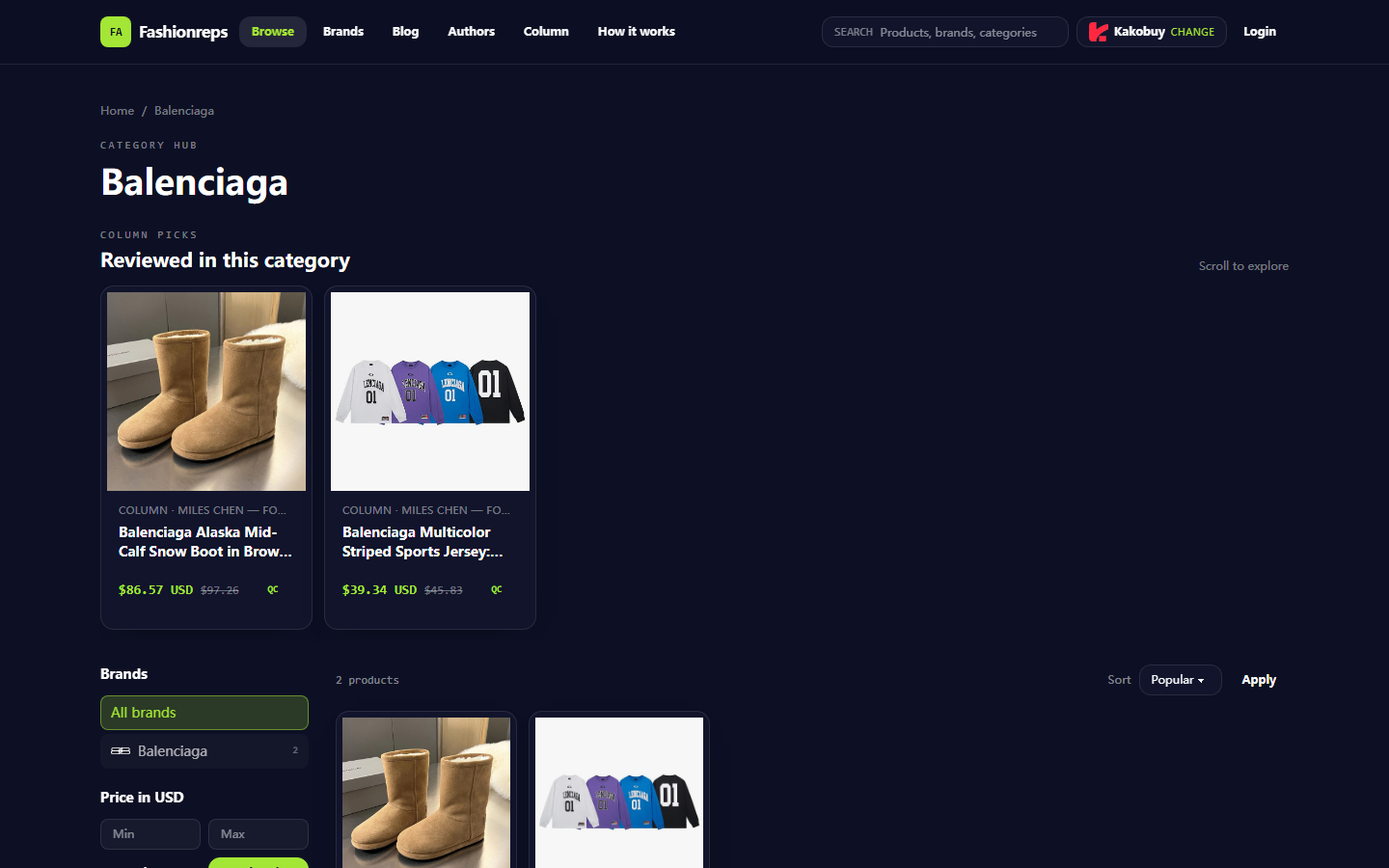
The image is used to illustrate the product page and evidence verification scenario. The screenshot in the currently available materials shows a Balenciaga category page, not a specific Dior shoe product page, so it cannot be used as Dior product or QC evidence.
First Confirm Product Page Style, Size, and Visible Images
The first step is not to zoom in on the shoe upper, but to confirm which specific shoe the page you are looking at corresponds to. Dior shoes may have different lasts, sole thicknesses, upper materials, colorways, and seasonal versions. A title containing only Dior, sneakers, or boots cannot confirm the specific model.
The current materials do not provide verifiable Dior product names, sellers, prices, inventory, size charts, product links, or specific QC photos. Therefore, this article does not make factual judgments about the appearance, size deviation, or inventory of a specific pair of Dior shoes.
Before purchasing, at least record the following fields:
- Product name and specific style, such as low-top, high-top, boots, or sandals.
- Colorway, upper material, and sole structure.
- Available sizes, sizing system, and whether foot length or insole length is provided.
- Whether product page images are of the same style, not category pages, recommendation images, or other colors.
- Reference price displayed on the page, update time, and currency.
- Seller information, product status, and whether the link opens normally.
- Purchase platform, purchasing agent, and after-sales window.
If the page only has a brand name and a distant view without a clear style, size, or detail images, mark it as insufficient evidence rather than assuming the product meets expectations.
How to Record Upper, Sole, Logo, and Structural Details
QC photos are suitable for visible surface checks. It is recommended to inspect in a fixed order to avoid focusing only on the most prominent logo:
- Overall upper: observe whether the left and right shoes are the same style, with consistent colors, stitching positions, and silhouettes.
- Toe and body: check left-right symmetry, wrinkle distribution, edge finishing, and obvious glue overflow.
- Sole: confirm that the tread pattern, thickness, edge bonding, and left-right height are roughly consistent.
- Logo details: check whether the logo position, font shape, embossing, or embroidery are clearly visible.
- Tongue, insole, and inner side: confirm whether there is sufficient clarity to judge stitching, labels, and lining structure.
- Heel and side: check heel height, stitching lines, and heel logo consistency between left and right.
- Packaging and accessories: only record what is actually shown on the page; do not assume that common packaging necessarily includes accessories.
Here, "recording" should use neutral descriptions as much as possible, such as "A visible edge irregularity on the right shoe's side," rather than directly writing "poor workmanship" or "definitely fake." Photo angles, lighting, and compression can affect judgment.
Example of Evidence Recording
| Check Area | Visible Facts That Can Be Recorded | Evidence Still Needed |
|---|---|---|
| Upper stitching | Whether left and right shoe stitching roughly aligns | Higher resolution close-up images |
| Sole | Tread pattern, thickness, and edges visible | Complete front, side, and bottom photos |
| Logo | Position, outline, and clarity | Close-up details and reliable reference of the same style |
| Internal label | Whether shown, clarity | Full label content and insole size |
| Packaging accessories | Items actually appearing in photos | Accessories clearly listed on product page |
Which Fields to Check for Size Information and Foot Fit
Brand sizing is not directly equivalent to suitable foot length. Last shape, toe room, upper wrap, sole structure, and sock thickness can change the actual experience.
Before purchasing, prioritize the following information:
- Your bare foot length, measured separately for left and right feet.
- Forefoot width and whether there are high insteps, wide feet, or toe deformities.
- Product sizing system, such as European size or other labeling.
- Foot length, insole length, or seller-measured data for the corresponding size.
- Toe shape, upper softness, and lace adjustment range.
- Whether thick socks are needed and the expected extra space.
- Return/exchange conditions, time window, and possible shipping costs.
If there is only a size chart without explaining the measurement method, treat the data as a reference value. Especially do not confuse insole length, internal shoe length, and suitable foot length. Their measurement positions are different and cannot be directly substituted one-to-one.
For people with wide feet or high insteps, simply increasing the size may lead to heel slippage and excessive shoe length. A safer approach is to first request supplementary information such as insole length, width, and upper height from the seller or warehouse before deciding to order.
How to Set Judgment Criteria for Scenarios Like Daily Commuting and Short Walks
Shoe judgment criteria should be determined by usage scenario. Daily commuting typically requires stable upper structure, no obvious abnormalities at the sole connection, sufficient fit evidence, and ability to withstand continuous walking. Short walks can accept less appearance detail evidence, but cannot ignore obvious asymmetry, sole deformation, or size uncertainty.
You can set minimum standards as follows:
- Daily commuting: need clear full-view left and right shoes, sole, and heel photos, and size at least based on foot length or insole length.
- Short walks: need to confirm toe room, sole condition, and basic wearing stability.
- Important occasions: in addition to fit evidence, also focus on color, logo, edges, and overall symmetry.
- Rainy days or complex road surfaces: cannot judge waterproof, wear resistance, or grip performance from appearance QC photos alone; do not make such promises without clear basis on the page.
- Long periods of standing: should further pay attention to sole hardness, internal support, and actual foot fit, which usually cannot be confirmed from ordinary QC photos.
If you cannot explain what scenario the shoes are mainly for, you should not rush to replace suitability judgment with "good-looking."
What QC Photos Can and Cannot Prove
QC photos typically help you check the visible appearance at the time of shooting, such as whether colors are obviously off, whether left and right shoes are mixed styles, whether there is visible damage to the sole, whether the logo is in the expected position, and whether there are obvious pre-shipping defects.
It cannot alone prove the following:
- The true composition, durability, or breathability of the upper material.
- Comfort, rubbing, and long-term stability after wearing.
- That the shoe size will definitely fit your foot shape.
- That the product in the photo definitely comes from the seller or batch stated on the page.
- That no crushing, contamination, or damage will occur during shipping.
- That the destination country will allow import or that no taxes will be incurred.
- That after-sales claims will definitely succeed.
Therefore, QC results should be written as "no obvious problem in the photo at the moment," not "quality guaranteed," "authentic guaranteed," or "definitely comfortable." When the page does not provide independent testing, complete measurements, or wearing records, these conclusions should not be added.
How to Label User Feedback and Page Facts Separately
Product page facts and user feedback must be separated. Product pages can provide style, images, size charts, prices, or seller statements; user feedback can only serve as additional clues and cannot replace the current product page and order evidence.
When reading feedback, at least record:
- The specific style and size the comment corresponds to.
- Comment date and whether it may belong to an older batch.
- Whether the user provides measured data, images, or subjective feelings.
- Whether the same issue appears in multiple independent feedbacks.
- Whether there is contradictory feedback.
Do not extend a single "runs large," "comfortable," or "good workmanship" into a conclusion that applies to all foot shapes and batches. If the feedback cannot confirm the corresponding style or size, mark it as a low-relevance reference.
fashion-reps' purchase process connects product discovery with external shopping agents; actual orders, payments, shipping, and after-sales are handled by the selected agent website. The current materials do not show which agent you selected, so cannot promise specific costs, logistics routes, or after-sales timelines. Re-confirm these conditions on the actual agent page before ordering.📦
Pre-Purchase Checklist and Conditions to Stop Ordering
Before placing an order, confirm item by item:
- The product page clearly identifies the specific Dior shoe style, not just brand or category information.
- Color, material, sole, and logo images belong to the same style.
- Sizing system, foot length basis, and measurement method are clearly visible.
- You have measured your left and right foot length and considered foot width, instep, and sock thickness.
- QC photos include full left and right shoes, sole, heel, toe, and key logos.
- Defects in photos have been distinguished as visible facts and subjective judgments.
- Price, inventory, seller, agent, shipping, and after-sales window have been re-verified on the day of purchase.
- QC photos are not used as proof of material, comfort, durability, or import compliance.
Stop ordering and supplement evidence first if any of the following occurs:
- Product link cannot be opened, redirects to an empty page, or only category pages can be seen.
- The page does not clearly state the specific style, and images appear to be of different shoes.
- No size chart, and unable to obtain foot length, insole length, or width information.
- QC photos are too far, too dark, or obstructed to judge key parts.
- Seller refuses to provide necessary size or defect explanations.
- The page writes unproven content as authentic, guaranteed comfort, or absolute durability.
- You cannot confirm the return/exchange window, destination country restrictions, tax liability, or actual agent.
The currently verifiable materials are insufficient to confirm whether a specific pair of Dior shoes is suitable for you, nor to make current factual judgments about its price, inventory, material, or quality. The safest next step is to supplement the specific product page, size chart, and complete QC photos, and then review according to the five levels of "style—size—structure—scenario—after-sales."👟