New Balance Winter Shoe Review: Fit and Use Limits
By Marcus Feld Editor-in-Chief
| Published | |
|---|---|
| Updated |
This new balance low-top lace-up sneaker's product page information is sufficient to support a pre-order verification, but not sufficient to prove that the specific item has undergone independent long-term wear testing by buyers. This article focuses on three actionable questions: what to prioritize when checking the last and sizing, what structural details the product page can prove, and whether it is suitable for commute walking, short trips, or ge
Editor score 4.2 / 5
This new balance low-top lace-up sneaker's product page information is sufficient to support a pre-order verification, but not sufficient to prove that the specific item has undergone independent long-term wear testing by buyers. This article focuses on three actionable questions: what to prioritize when checking the last and sizing, what structural details the product page can prove, and whether it is suitable for commute walking, short trips, or genuine sports scenarios. The facts in this article are based on the visible information on the fashion-reps product page, with the page's stated update date of September 26, 2026; prices, variants, service fees, and international shipping costs still need to be reconfirmed on the selected shopping agent page before ordering. 🔎

Clarify the Evaluation Task and Evidence Scope for the new balance Fall/Winter Sneakers
The goal of this evaluation is not to label the product as "authentic" or "best," but to help buyers layer evidence before ordering:
- Confirm the publicly stated upper, lining, insole, outsole, closure method, and size range on the product page.
- Identify the most error-prone aspects of sizing judgment, especially toe room and wide-foot adaptability.
- Distinguish between product page facts, public feedback at the brand level, and cautious judgments made by the editor based on available information.
- Specify which missing information should prompt pausing the order and confirming variants, actual photos, and return/exchange conditions with the shopping agent.
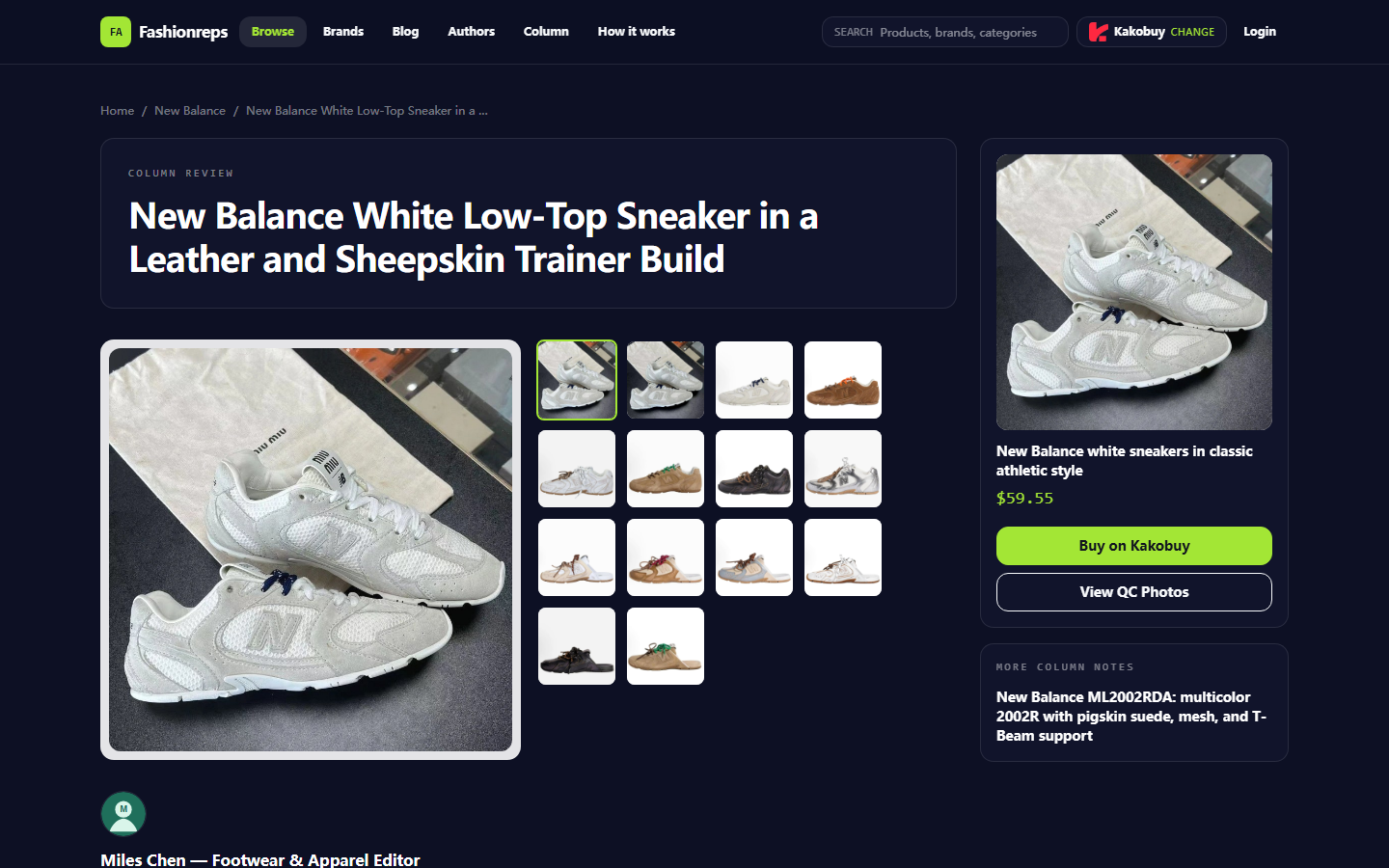
The current page describes these shoes as low-top, lace-up, casual style, listing two colors: white and khaki, with sizes 35–40. The page also states that the upper is leather, the lining is sheepskin, the insole is natural leather, the outsole is rubber, the heel height is about 1–3 cm, and the applicable seasons are spring, summer, autumn, and winter.
These contents can be treated as product page claims but cannot automatically be equated with physical inspection results. The currently visible information does not provide independent buyer reviews, foot length measurements, internal shoe length, toe box width, or wear mileage for this specific item, so comfort of the last, durability, and cold protection still carry uncertainty.
Record the Visible Shoe Type, Sizing, Colors, and Specifications on the Product Page
| Item | Product Page Visible Information | Still Needs Verification Before Ordering |
|---|---|---|
| Shoe type | Low-top, lace-up, casual sneakers | Actual height, ankle collar wrap, and ankle movement space |
| Colors | White, khaki | Specific inventory, color batches, and color differences |
| Sizes | 35–40 | Internal shoe length, foot width, and actual measurements for different sizes |
| Material claims | Leather upper, sheepskin lining, natural leather insole, rubber outsole | Whether material labels match the actual product and detail images |
| Structural info | Lace-up closure, cemented construction | Outsole edges, glue lines, delamination, and excess glue |
| Price info | Page shows reference price $59.55, final product price $68.53 on checkout page | Agent service fees, international shipping, taxes, and exchange rates |
The page's reference price and final product price cannot be directly considered the total cost. The shopping agent page may separately calculate service fees and international shipping costs, and destination country taxes may also depend on route, declaration, and local regulations. When purchasing, use the final checkout page as the authority, and confirm whether the item still has the corresponding color and size.
Determine Sizing Verification Focus Based on Toe Room and Last Description
Existing public information mentions that some New Balance lifestyle shoe models may run wide, and people who prefer a snugger fit sometimes consider sizing down half a size; meanwhile, feedback from wide-foot buyers on low-top, low-profile models may be the opposite, considering the toe box area tight and tending to choose the larger size when between sizes. This judgment is a reference at the brand or model level, not a tested conclusion for this specific item.
Therefore, sizing verification should proceed in the following order:
- First measure foot length and forefoot width while wearing the socks intended for use, and note any left-right differences.
- Ask the shopping agent for the internal length of that size, insole length, and visible toe box width.
- If you have wide feet, high instep, or are exactly between two sizes, do not decide solely based on generalizations of "runs large" or "runs small."
- Have the agent confirm the size label, that left and right shoes are the same size, and the size information on the box or packaging.
- Compare with the internal length of your frequently worn shoes, rather than just comparing nominal sizes across brands.
Toe room in low-top shoes deserves particular attention. Even if the length is sufficient, if the forefoot width is inadequate, toes may still be squeezed; conversely, blindly choosing a size up may cause heel slippage and increased creasing. For wearing thick socks in autumn and winter, sock thickness should also be factored into measurements, rather than relying on conclusions from summer thin socks. 🧦
Review Visible Evidence of Upper, Outsole Tread, and Structural Details
The product page declares a leather upper, sheepskin lining, natural leather insole, and rubber outsole, but the public information does not provide sufficiently detailed physical measurements to judge leather thickness, lining warmth, or the actual rubber compound of the outsole. Buyers should treat these descriptions as items to be verified.
It is recommended to request clear QC images from the shopping agent, covering at least:
- Left and right shoe toe boxes, lateral side, medial side, heel, and ankle collar.
- Upper seams, stitching density, thread ends, and edge finishing.
- Heel stitching position and the connection between the upper and outsole.
- Outsole tread, forefoot flex zone, and heel wear surface.
- Insole surface, lining fuzz, and size label.
- Outsole edges for any obvious excess glue, gaps, lifting, or asymmetry.
In public discussions about New Balance, some believe that certain of its same-price lifestyle models are competitive in comfort and workmanship; there are also negative reviews on brand's official evaluation pages showing outsole detachment, need for re-gluing, and difficulties with after-sales repair. These contents only indicate that brand-level reputation varies, and cannot prove that this pair will or will not have the same issues.
When verifying images, the focus is not on finding an angle that "looks good," but on finding details that can rule out risks. If heel stitching, outsole attachment, and left-right symmetry cannot be clearly seen, the product page's material descriptions should not be taken as complete quality evidence. 🧵
Distinguish Between Commute Walking, Short Trips, and Sports Use Scenarios
From the visible page information, these shoes are more appropriately evaluated as casual styling and daily walking shoes, rather than directly as professional running shoes, training shoes, or harsh weather outdoor shoes.
For commute walking, the low-top design, lace-up closure, low heel, and rubber outsole can support general city pavement use. But comfort still depends on internal length, toe box width, insole support, and personal foot shape, and the product page does not provide enough data to confirm long-duration walking performance.
For short trips, if the buyer has confirmed via QC images that the outsole attachment, upper seams, and sizing are appropriate, they can be used as casual shoes. The white upper should also consider rain, dirt, and daily cleaning costs; the page does not provide a waterproof rating or special stain-resistant treatment claim, so "suitable for autumn and winter" should not be interpreted as a promise of waterproof or snow performance.
For sports use, a higher degree of caution should be maintained. The existing information does not provide cushioning structure, arch support, traction tests, durability tests, or running suitability instructions. For running, ball sports, long-distance hiking, or high-frequency training, do not treat them as professional sports equipment based solely on appearance, brand name, or rubber outsole. 🏃
Separate Product Page Facts, Verifiable Feedback, and Editorial Judgment
Confirmable product page facts include: size range 35–40, colors white and khaki, page declares leather upper, sheepskin lining, natural leather insole, rubber outsole, uses lace-up closure, heel height about 1–3 cm, and marked as suitable for four seasons.
Feedback that can be referenced but not applied directly to this item includes: some New Balance lifestyle models are described as running wide; wide-foot buyers may find low-top toe boxes tight; community users have positive views on comfort and quality of the brand's same-price models; brand review pages also have negative reports of outsole detachment and after-sales difficulties.
Still part of editorial judgment includes: whether these shoes fit a particular buyer's foot shape, whether the leather and sheepskin claims fully match the physical product, whether the outsole can withstand high-frequency walking, and warmth and slip resistance in autumn and winter environments. Without independent buyer feedback and physical measurements for the specific item, these judgments should not be written as verified conclusions.
Stop Conditions When Information Is Missing or Images Are Insufficient
If any of the following occurs, it is recommended to pause the purchase:
- The target color or size cannot be confirmed as in stock on the agent page.
- The agent cannot provide clear images of internal length, size label, or toe box area.
- There is obvious asymmetry between left and right shoes, outsole lifting, delamination, severe excess glue, or broken stitching.
- The product page material claims do not match the QC images, and the seller or agent cannot explain.
- The return/exchange window, return costs, and return path are unclear.
- The buyer needs professional running, ball training, long-distance hiking, or explicit waterproof performance.
- The final settlement amount does not yet include service fees, international shipping, and possible taxes.
If only a decorative image is missing, it may not affect judgment; but if key evidence of toe box, heel, outsole attachment, or size label is missing, do not use "images look roughly normal" as a substitute for verification.
Pre-Order Checklist for Size, Variant, and Page Status Review
Before ordering, complete the final checks in the following order:
- Record your foot length, forefoot width, left-right difference, and planned sock thickness.
- Compare foot measurements with the internal length, insole length, and toe box width provided by the agent.
- Confirm that color, size, left/right labels, and quantity are correct.
- Review QC images of toe box, heel, stitching, outsole tread, glue edges, and internal labels.
- Confirm current page price, agent service fees, international shipping, taxes, and exchange rate impact.
- Read return and exchange conditions, especially for size mismatch, quality issues, and return shipping costs.
- Save pre-order page screenshots and agent confirmation for later verification.
Based on the existing evidence, these shoes can be a candidate as casual low-top shoes for urban commute walking or short trips, but size measurement and key area QC verification should be completed first. For those with wide feet, high instep, or needing professional sports performance, the product page information is still insufficient; it is recommended to obtain actual measurement data first, and if necessary choose alternative models with clear last parameters and sports use descriptions. ✅
Article Images