Reading Lacoste Knitwear Pages: Fit, Fabric, Size Evidence
By Marcus Feld Editor-in-Chief
| Published | |
|---|---|
| Updated |
## What Purchase Problem Does This Lacoste Knitwear Review Solve? This guide solves a specific problem: when you see a Lacoste fall/winter top or suspected knitwear product page on fashion-reps, how to distinguish between facts explicitly stated on the page, structural information observable in the images, and d
Editor score 4.2 / 5

What Purchase Problem Does This Lacoste Knitwear Review Solve?
This guide solves a specific problem: when you see a Lacoste fall/winter top or suspected knitwear product page on fashion-reps, how to distinguish between facts explicitly stated on the page, structural information observable in the images, and details that still need to be verified with the product page or seller.
After reading, you should be able to complete three steps: confirm the style and visible specs, build a record of fabric and image evidence, and then compare your own body measurements against the size chart. This article does not claim to have purchased, received, worn, or touched the item, nor does it treat page images as results of physical inspection.
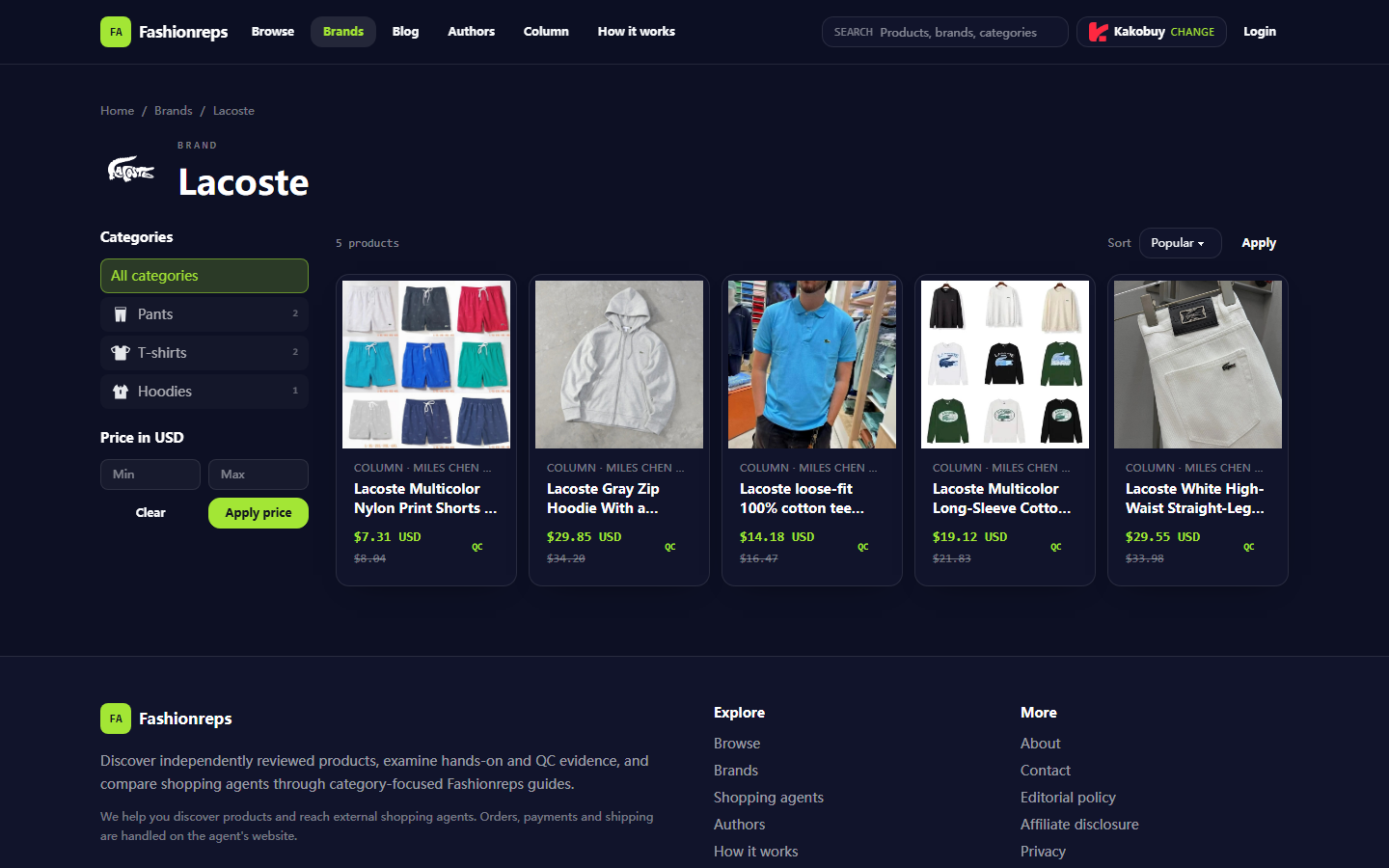
The verification date for this review is October 8, 2026. Visible information comes from screenshots of the Lacoste brand page on fashion-reps. At that time, the page displayed 5 Lacoste items, with category filters including Pants, T-shirts, and Hoodies, but the screenshots did not clearly list any items named knitwear, sweater, or cardigan. Therefore, this article cannot confirm the specific price, stock, fiber composition, thickness, or size range for this knitwear that was not clearly displayed. 🧾
First Confirm the Style, Color, and Visible Specs on the fashionreps Page
Start with the product title, not the brand name. The Lacoste page in the screenshots displayed the following types of title information:
- Multicolor Nylon Print Shorts, size range M–4XL
- Gray Zip Hoodie, labeled relaxed unisex cut, and mentioned having a matching pant option
- Loose-fit 100% cotton tee with embroidered logo and colorblock panels
- Multicolor Long-Sleeve Cotton Tee Collection with geometric print, size range S–4XL
- White High-Waist Straight-Leg Jeans, labeled stretch fabric and Style H069
These titles can help you understand how the page expresses color, fit, material, size, and style number, but they are not evidence for knitwear. You cannot infer that the target item has the same attributes just because the same brand page shows cotton, relaxed, long-sleeve, or matching options.
When reading a product page, it is recommended to record in the following order:
- The category in the product title, such as sweater, crewneck, cardigan, or knit polo.
- Whether the color is explicitly stated in text or can only be inferred from images.
- Whether the fit has explicit descriptions like relaxed, regular, slim, or oversized.
- Whether the page provides a style number, size range, and available variants.
- Whether the reference price is the value currently displayed on the page, and whether original or historical price is noted.
- Whether there is a separate size chart, seller information, product details, and QC images.
The page in the screenshots shows that some items have a Reference price, for example, a gray zip hoodie shows 29.85 USD, and a loose-fit cotton T-shirt shows 14.18 USD. These are the reference prices displayed at that time, not the knitwear price, and not the final payment amount, agent service fees, domestic shipping, international shipping, taxes, or return/exchange costs. 💵
What Fit and Structural Information Can Be Directly Observed in Product Images
Product images can provide initial visual clues, but they only support limited conclusions. For knitwear, prioritize observing the following areas:
- Shoulder line: Determine whether the shoulder is a natural drop shoulder, regular shoulder line, or obviously extended.
- Neckline: Record round neck, V-neck, collar, or half-zip design, and whether there is obvious ribbing at the neckline.
- Body: Compare front and back length, visual chest width, and hem closure.
- Sleeves: Observe armhole position, sleeve width, and whether cuffs are tightened.
- Hem: Confirm if straight, ribbed, or with slits.
- Pattern: Record if the pattern is on the chest, sleeves, all-over, or in partial panels.
These observations can only describe the appearance shown in the image. For example, you can write "the image shows the hem appears to have a ribbed closure," but you cannot directly write "the hem has good elasticity" or "it will not deform when worn." The latter two require physical testing, material data, or reliable measurement records.
Similarly, appearing thick in an image does not equal verified warmth; visible surface texture does not necessarily mean it is wool, cashmere, or a specific knit stitch. If the product page lacks clear composition labels and craft descriptions, mark these as to be verified. 🔍
How Fabric Labels Should Be Recorded Separately from Page Images
Fabric information should primarily come from product page text, photos of material labels, or explicit seller statements. Images can only help you observe surface texture, knit direction, apparent thickness, and whether there are color blocks; they cannot independently prove fiber composition.
| Record Item | What Can Be Directly Recorded | What Should Not Be Directly Inferred |
|---|---|---|
| Page Text | Explicitly stated fiber percentages, fabric names, or care instructions | Fiber percentages not stated on the page |
| Product Images | Visible texture, ribbing, color panels, neckline and cuff structure | Handfeel, warmth, durability of elasticity |
| Label Photos | Readable composition, size, and care information on the label | Actual quality judgments beyond the label |
| QC Images | Recognizable stitching, placement of prints/embroidery, and obvious flaws in the images | Overall workmanship in areas not shown |
In the visible summary of the Lacoste brand page, some product titles include "100% cotton," "cotton tee," or "nylon," but no fabric label for the target knitwear is shown. Therefore, you cannot apply the fabric information from these T-shirts or shorts to the knitwear.
If the product page only provides blurry images, you should request clearer composition label photos, size labels, and QC photos of key areas before purchasing. For fall/winter knitwear, at a minimum, confirm the neckline, cuffs, hem, underarm seams, and front pattern area. If you cannot obtain this evidence, lower your confidence level regarding fabric and workmanship rather than filling the gap with brand impressions.
What Length and Cuff Information to Check for Fall/Winter Layering
The most common problem with fall/winter layering is not necessarily insufficient chest room, but rather that the length, sleeve length, and cuffs are not coordinated with inner and outer layers. When reading a product page, prioritize the following measurements:
- Chest or half-chest: To determine if a T-shirt, shirt, or thin base layer can fit underneath.
- Body length: To determine if it is too short when worn alone, or if too much shows when layered under a jacket.
- Shoulder width: To determine the difference between regular shoulder line and drop shoulder styles.
- Sleeve length: Especially whether cuffs will be pressed by jacket cuffs or show too much.
- Cuff width: Ribbed cuffs that are too tight may affect layering; too loose may affect wind resistance.
- Hem width: Needs to be judged together with the outer jacket hem and personal wearing habits.
If the page does not explain the measurement method, do not directly compare numbers from different items. Flat lay measurement, wrap-around measurement, and garment natural state measurement will produce different results. When comparing, confirm the units, measurement starting points, whether ribbing is included, and whether error ranges are stated.
The fashion-reps page itself emphasizes helping users discover products, view QC evidence, and compare shopping agents; orders, payments, and shipping are handled by external agent websites. Therefore, product page judgment is not the same step as final ordering, payment, warehouse inspection, and logistics arrangements. After entering the agent platform, you need to reconfirm variants, stock, fees, and return/exchange conditions. 📦
How Size Charts, Measurement Instructions, and Personal Data Correspond
Size verification should start with measuring yourself, then look at the product size chart. It is recommended to wear a fall/winter top that you think fits well, record chest, shoulder width, body length, and sleeve length, and note the measurement state. Do not choose a size based only on height, weight, or brand conventions.
Recommended correspondence method:
- First confirm your measurement unit and convert it to the unit used on the product page.
- Confirm whether the product page uses garment measurements or recommended body measurements.
- Compare chest, shoulder width, body length, and sleeve length item by item; don't just look at one largest number.
- If planning to layer, additionally record the thickness of inner layers and allowance for movement.
- For pages without clear error statements, mark size judgment as medium or low confidence.
- If two sizes are close, prioritize confirming actual measurements, elasticity, and return/exchange conditions with the seller.
In the visible Lacoste product titles in the screenshots, some items show size ranges like M–4XL or S–4XL, but this does not mean the target knitwear offers the same range, nor that every size is in stock. Size range is only visible page information and cannot replace an independent size chart for the knitwear.
If the page does not have a size chart, measurement instructions, or clear product variants, it is not recommended to order based solely on descriptions like "relaxed" or "loose-fit." They can indicate fit direction but do not provide actionable data for chest, body length, or sleeve length. 📏
Which Pros and Cons Are Editorial Interpretation Rather Than Page Facts
Based on currently visible information, it can be confirmed that the Lacoste brand page on fashion-reps provides brand filtering, product titles, some reference prices, category entry points, and a QC-related interface. The page also states that its function is to help users discover products, view independent reviews and QC evidence, and complete orders, payments, and shipping through external shopping agents.
This information supports the following limited judgments:
- The page is suitable as an entry point for product discovery and preliminary evidence organization.
- Titles can provide clues about color, category, fit, material, or size range.
- Reference prices should be considered page display information and not directly taken as final cost.
- When product page evidence is insufficient, you need to proceed to the specific product page or agent process for further verification.
However, the following cannot currently be confirmed from visible information:
- The specific product link, price, and stock of the target Lacoste knitwear.
- The actual fiber composition, knit stitch, thickness, elasticity, and warmth of the knitwear.
- Whether the target item has been independently purchased, received, or physically tested.
- The actual size error, post-wash changes, and durability of the target item.
- Final agent fees, international shipping, taxes, return/exchange outcomes, and logistics timeliness.
Therefore, this article does not use unverified conclusions like authentic, guaranteed, best, or trusted, and does not pass off other Lacoste items on the page as knitwear samples.
Evidence Checklist for Lacoste Knitwear Before Purchase
Before ordering, save evidence in the following order:
- [] The product title clearly states the knitwear category, not just Lacoste or fall/winter top.
- [] Color and style variants are visible in page text or options, not just relying on the main image.
- [] The page provides an independent size chart and explains flat lay or wrap-around measurement method.
- [] Record chest, shoulder width, body length, sleeve length, and cuff measurements.
- [] Fabric composition comes from text, label photos, or explicit seller statements.
- [] There is sufficiently clear QC evidence for neckline, cuffs, hem, underarms, and pattern areas.
- [] Reference price is recorded separately from final agent fees, domestic shipping, international shipping, and taxes.
- [] Confirm current stock, variant availability, and return/exchange window; do not treat old page information as current.
- [] Do not publicly post order numbers, payment cards, complete shipping labels, or other personal information to request help.
- [] If key evidence cannot be verified, pause the purchase, or choose an item with more complete evidence.
Final judgment can be recorded in your own purchase notes: what are the page facts, what can be observed from images, what still needs verification, and whether you are willing to accept size, fabric, and return/exchange risks if evidence is insufficient. For the visible page this time, the safest conclusion is: fashion-reps provides an entry point for Lacoste product discovery and preliminary verification, but the current screenshots are insufficient to support specific conclusions about fabric, fit, size, or quality for a particular Lacoste knitwear.