Tommy Hilfiger Knitwear: Fashionreps vs Other Platforms
By Marcus Feld Editor-in-Chief
| Published | |
|---|---|
| Updated |
Defining the Platform Comparison Task for Tommy Hilfiger Knitwear If you're planning to buy Tommy Hilfiger knitwear, what you really need to compare isn't just the page price, but whether you can confirm the specific style, color, size, order notes, and whether you can see clear inbound and warehouse status after payment. This process suits buyers who have already found candidate items but can't yet judge whether platform information is complete enough. The scope of this article is limited to
Editor score 4.2 / 5
Defining the Platform Comparison Task for Tommy Hilfiger Knitwear
If you're planning to buy Tommy Hilfiger knitwear, what you really need to compare isn't just the page price, but whether you can confirm the specific style, color, size, order notes, and whether you can see clear inbound and warehouse status after payment. This process suits buyers who have already found candidate items but can't yet judge whether platform information is complete enough.
The scope of this article is limited to what can be verified on the page. Fashionreps' public pages indicate that it is used for product discovery, viewing product information and QC evidence, and leaves the purchasing process to an external shopping agent chosen by the user; payment, orders, and shipping are handled by the agent's website. The page also explicitly lists multiple selectable shopping agents. 🧾
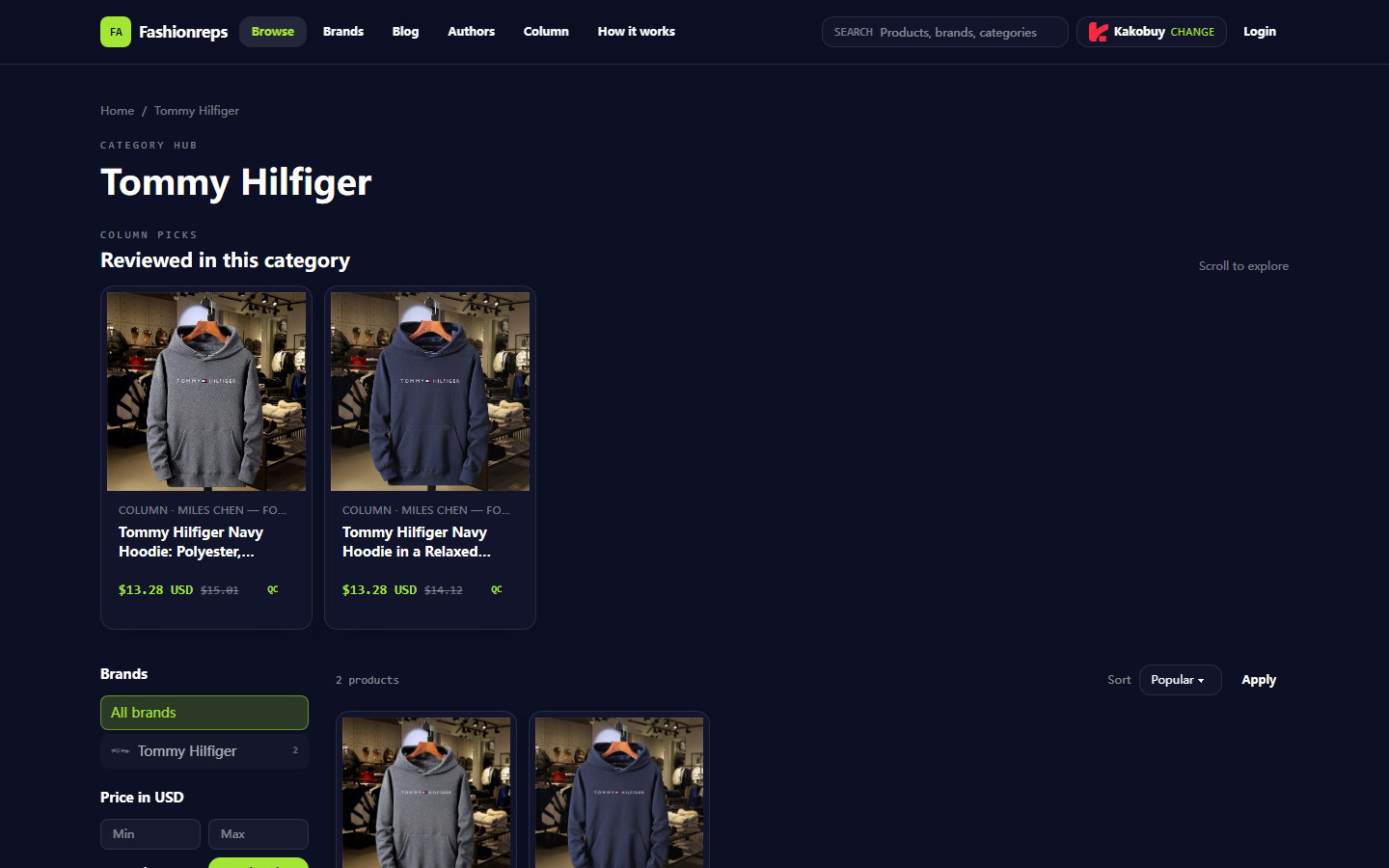
An important limitation needs to be stated upfront: the currently visible Tommy Hilfiger category data shows two hoodies, with page information including polyester, sizes S–XXXL, number of colors, and reference prices, but this data cannot directly prove the material, knit, fit, or stock of a specific Tommy Hilfiger knitwear item. Therefore, the hoodie pages must not be treated as knitwear specifications, nor can you infer the actual status of other items from the same brand based on them.
After reading, you should be able to do three things: confirm whether the target item is truly knitwear; put specifications and order information from different platforms into one record; and determine before paying which platform makes it easier for you to spot variant errors, missing notes, and unclear inbound status. If you already have a specific product link, you should still recheck the current page item by item, rather than ordering based only on the brand name or thumbnail.
Checking Colors, Sizes, Styles, and Current Links on Fashionreps
Fashionreps' Tommy Hilfiger category page provides brand filters, price filters, sorting, and product cards. The visible samples include two Tommy Hilfiger hoodies: one labeled navy, polyester, hooded, and S–XXXL, and the other described as an oversized street fit with 13 colors. The page also shows reference prices, but reference prices are not the checkout price, nor do they equal current stock or final cost including shipping.
When checking knitwear, it's recommended to record the following fields one by one:
- Product page title and full URL
- Product type: knitwear, cardigan, sweater, or other top
- Material label and its original text; don't treat marketing words like "soft" or "warm" as composition
- Whether color name, color code, and variant images match
- Size range, size chart units, and whether garment length, chest, and sleeve length are provided
- Current page price, price currency, and recording date
- Whether there are QC photos or other visible product evidence
- The target link after entering the shopping agent and how variants are selected
It's especially important to distinguish "the page shows multiple colors" from "the color you want is still in stock." The former only proves that the page once listed these variants, not that they can be purchased at the time of payment. The same goes for sizes: S–XXXL represents the size range shown on the page, not that every size is currently selectable.

Figure: Illustration of Fashionreps' product discovery, shopping agent selection, and QC information path. The figure shows the public page flow and is not proof of Tommy Hilfiger knitwear stock or physical quality.
Building Same-Style Specification and Source Records for Other Platforms
When comparing with other platforms, the first principle is to compare the same item, not just the same brand. At minimum, the following conditions must be met to call it a "same-style comparison": product images or style numbers correspond; color names and size systems are consistent; material or product label information has no obvious conflicts; seller or product source is traceable; and the page status can be rechecked on the recording date.
If another platform only provides a brand name, vague images, and low prices without clear material, size chart, or seller source, it should be recorded as "insufficient information" and not listed as a better option. If a page is dead, auto-redirects, only has tag lists, or lacks a clear product name, it should not be used as a reliable comparison sample.
| Comparison Field | What Fashionreps Page Can Verify | What Other Platforms Must Provide | What Cannot Be Directly Inferred |
|---|---|---|---|
| Product Identity | Brand category and product card | Full product name, style number, or traceable source | Authenticity or same production batch |
| Specifications | Style, partial material, and size info shown on page | Material label, size chart, color, and fit | Actual feel, thickness, and wearing effect |
| Price | Page reference price | Current checkout price, currency, and additional fees | Final landed cost |
| Evidence | Visible product description and QC entry info | Product images, detail shots, seller description, and update time | Physical item has no flaws |
| Status | Path to select shopping agent | Post-payment order, inbound, and warehouse records | Guaranteed on-time shipping |
This table's purpose is to prevent information from being mixed together. Fashionreps' page discovery capability, the shopping agent's order capability, and the seller's actual supply capability belong to different stages, and you should not treat visible information from one stage as the entire transaction guarantee.
Comparing Visible Paths for Order Notes, Variant Confirmation, and Modification Information
The most error-prone part of knitwear is usually not the brand name but the color, size, and style variant. Before ordering, write your selections as a reviewable order note, for example: "Color: dark gray; Size: M; Style: crew neck knitwear; if this color is out of stock, please contact first, do not auto-substitute." Do not rely solely on image order or thumbnail position.
When comparing platforms, focus on the following questions:
- Does the order page show the full color and size, rather than just a generic product name?
- Will the note be saved with the order and remain viewable after payment?
- After changing a variant, does the system show a new price or stock alert?
- If the seller cannot supply, will there be a cancellation, swap, or refund record?
- Can customer service replies correspond to a specific order, rather than just template responses?
- Do order status changes include timestamps, processing steps, or operation notes?
If the platform only allows sending notes in chat and the order page doesn't keep them, later verification becomes more difficult. Chat logs can supplement but should not replace the color, size, and style fields in the order. For highly volatile information like price, stock, and links, record the verification date again before ordering.
Comparing Post-Payment Order Status, Inbound Notices, and Warehouse Records
Payment completion does not mean the item has entered the warehouse. A more useful comparison method is to break status into sequential nodes: payment successful, seller processing, seller shipping, warehouse receipt, QC or inspection data generated, inbound completed, waiting for consolidation, and final shipment.
For Fashionreps, the public pages mainly serve product discovery and shopping agent selection; specific order status depends on the chosen external agent account. When comparing other platforms, also confirm whether they can show the same level of detail, rather than just "processing" or "completed."
It is recommended to save the following records:
- Order number and order date
- Product link, color, size, and original note text
- Payment amount and currency
- Seller shipping time and tracking number, if provided on the page
- Warehouse receipt time
- Whether QC images or inspection results appear
- Visible information such as inbound quantity, weight, or storage location
- Status of out-of-stock, variant errors, flaws, and refund processing
Warehouse status is especially useful for spotting process breaks. For example, if an order shows the seller has shipped but there is no warehouse receipt record after several days, that only indicates a gap in the current record, not necessarily that the package is lost. Conversely, if the platform can show receipt time, item quantity, and QC data, buyers can spot problems before consolidation more easily. 📦
Comparing Customer Service and Follow-Up Support Only When Page Evidence Exists
Customer service comparisons must be based on visible records. You cannot infer a platform responds faster just because it has an online chat button, nor that all cases can be refunded just because the page provides a refund portal.
When comparing, record whether customer service answers specific questions: whether the knitwear color is available, what units the size chart uses, whether variants can be modified, how issues found after inbound are handled, and the applicable conditions for refunds or exchanges. For every interaction, keep the date, question, response content, and corresponding order, not just "customer service said yes."
If the page does not publicly state complete policies, write "not verified on current page" rather than adding speculation. Platform policies, seller stock, shipping fees, taxes, and return windows may change, so recheck before publishing or ordering.
Separating Platform Facts, User Actions, and Unknown Conditions into Columns
To avoid writing judgments as facts, use a three-column recording method:
- Source Facts: What the page currently and explicitly shows, such as product name, price labeling, size range, shopping agent entry, or order status
- User Actions: The color, size, note, payment, and warehouse processing actions you have chosen
- Unknown Conditions: Unconfirmed stock, material authenticity, actual dimensions, final shipping, taxes, seller response, and return outcomes
This column separation is more reliable than simply ranking platforms. One platform may be clearer in product discovery and link organization, another more transparent in order records or warehouse status, but that does not automatically mean one platform wins at all stages. The final choice should depend on which risk you worry about most: variant errors, insufficient product information, invisible status, or difficult after-sales communication. 🔍
Final Actions: Decide Based on Specification Confirmation and Status Transparency
Before ordering, follow this sequence:
- Confirm the page is indeed Tommy Hilfiger knitwear, not a hoodie, sweatshirt, or other top.
- Save the product name, link, color, size, material, and price, and note the verification date.
- Look for corresponding same-style data on other platforms; brand name alone is not enough for a same-style comparison.
- Write the color, size, style, and out-of-stock handling into the order note.
- After payment, check whether the order fields retain the note, and wait for seller processing and warehouse inbound records.
- Before consolidation, check QC or inspection data; if you find variant, quantity, or obvious appearance issues, pause shipment and use the platform's support process.
- Decide whether to proceed based on actual costs, warehouse status, and risk tolerance, not just the page reference price.
This method saves not a fixed guaranteed amount but reduces extra costs from buying the wrong color or size, repeated communication, incorrect consolidation, and late problem discovery. The added cost is recording specifications, saving screenshots or order info, and spending time reviewing before payment. It suits buyers who value variant accuracy, want to see warehouse nodes clearly, and are willing to keep their own evidence; it is not for those who just want to order quickly at the lowest listed price and don't plan to check material and size.
If the product page cannot confirm the knitwear identity, other platforms have no reliable same-style specifications, or you cannot view order notes and warehouse status after payment, it is advisable to hold off on purchasing. Continuing to compare prices often won't solve the core information gap.
Agent Platform Shopping FAQ
1. What do QC photos on repgalaxy.tips refer to?
Every item forwarded through repgalaxy.tips, after being stored in its warehouse, undergoes inspection and QC photo shooting by the platform's professional quality control team. They typically take three photos, checking whether the item's color, size, specifications, and quantity match your order, and also checking for quality issues. However, electronics are an exception—only appearance is checked. If quality problems or size/color mismatches are found, the QC team will immediately request a return from the seller, ensuring you receive good-quality items.
2. Why is it not recommended to use Google Sheets to manage products on repgalaxy.tips?
Google Sheets is only suitable for very small numbers of products. Once products increase, loading becomes very slow and the system lags badly, especially on mobile, making finding products very inconvenient. In contrast, repgalaxy.tips' built-in website table loads faster and offers a better visual experience.
3. What kinds of products are available on the repgalaxy.tips website?
The repgalaxy.tips website covers many product categories, including shoes, T-shirts, sweaters, hoodies, jeans, sweatpants, shorts, beach shorts, factory clearance items, down jackets, baseball shirts, shirts, hats, jewelry, bags, electronics, sunglasses, socks, underwear, and trendy collectibles.